📊 Full opportunity report: Incident postmortem builder for managed service providers on IdeaNavigator AI — validation score, market gap, and execution plan.
TL;DR
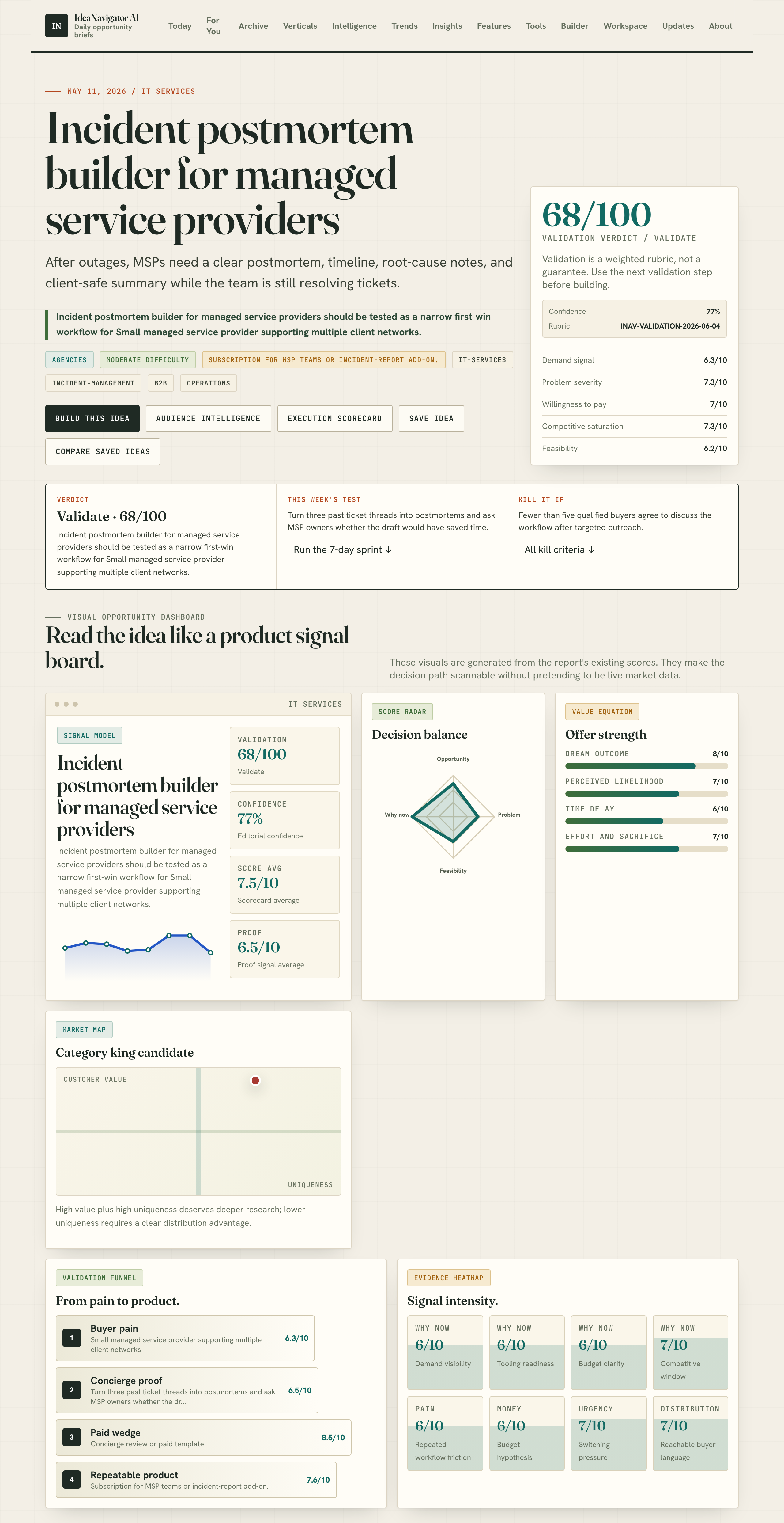
A new incident postmortem builder aimed at small MSPs is in testing, promising faster, clearer incident reports. It supports importing ticket notes, timestamping, and separating internal and client-facing language. Its success could improve incident communication for MSPs.
A new incident postmortem builder designed specifically for small managed service providers is in the testing phase, aiming to streamline the creation of incident reports after outages. This tool is intended to help MSPs generate clear, client-safe summaries, timelines, and root-cause notes quickly during ongoing incident resolution.
The proposed postmortem builder is targeted at small MSPs supporting multiple client networks. It features a workspace that imports ticket notes, timestamps key events, and separates internal technical language from client-facing communications. The goal is to enable MSP teams to produce professional incident reports rapidly while they are still resolving tickets.
According to developers, the MVP (minimum viable product) will include functionalities such as importing existing ticket data, organizing incident timelines, and drafting next steps. The product aims to address the common challenge faced by small MSPs: providing timely, clear incident communication that meets client expectations, even when the team is still troubleshooting.
Market validation plans involve converting three past ticket threads into draft postmortems and consulting MSP owners to determine if the tool would have saved time and improved communication. The service is expected to operate on a subscription model for MSP teams or as an incident-report add-on feature.
Potential Impact on Small MSP Incident Management
If successful, this incident postmortem builder could significantly improve how small MSPs handle post-incident communication, making reports faster, more consistent, and more professional. This can enhance client trust and satisfaction, especially as clients increasingly expect detailed and timely incident updates from all technical providers, regardless of size.
Furthermore, the tool could reduce internal workload by automating parts of the report drafting process, allowing MSPs to focus more on resolving outages rather than documentation. Its adoption may also set a new standard for incident communication practices among small MSPs, influencing broader industry norms.
incident report management software for MSPs
As an affiliate, we earn on qualifying purchases.
As an affiliate, we earn on qualifying purchases.
Growing Demand for Professional Incident Communication in MSPs
Small managed service providers often face challenges in producing incident reports that are both comprehensive and client-friendly, especially during ongoing outages. Currently, many rely on manual note-taking and post-incident summaries that can be time-consuming and inconsistent.
The increasing expectations from clients for transparency and professionalism in incident handling have prompted MSPs to seek better tools. The concept of an incident postmortem builder has emerged as a potential solution, initially tested by larger organizations but now being tailored for smaller MSPs supporting multiple clients.
This development aligns with broader trends in IT services, where automation and streamlined workflows are becoming critical for competitive advantage and customer satisfaction.
“The goal is to help small MSPs produce incident reports that are clear, professional, and generated in real-time, even during ongoing outages.”
— an anonymous developer involved in the project
IT incident postmortem builder tool
As an affiliate, we earn on qualifying purchases.
As an affiliate, we earn on qualifying purchases.
Uncertainties Around Tool Adoption and Effectiveness
It is not yet clear how widely small MSPs will adopt this postmortem builder or whether it will significantly reduce report preparation time in practice. The effectiveness of the MVP in real-world scenarios remains to be validated through user testing and feedback.
Additionally, it is uncertain how the tool will integrate with existing ticketing and incident management systems, and whether MSPs will find the separation of internal and client-facing language intuitive and useful.

4-Pack Stainless Steel Receipt Spike & Ticket Holder – 5.5 Inch Rustproof Bill Fork for Home, Restaurant, Office – Heavy Duty Ticket Stabber & Receipt Holder Organizer
【Sturdy Stainless Steel Receipt Spike】Made of high-quality rustproof stainless steel, this 5.5-inch receipt spike resists bending and corrosion….
As an affiliate, we earn on qualifying purchases.
As an affiliate, we earn on qualifying purchases.
Next Steps for Development and Validation
The developers plan to test the MVP by converting three past outage tickets into postmortem drafts and gathering feedback from MSP owners. Based on this, they will refine features and usability. Further, they aim to pilot the tool with a small group of MSPs to evaluate its impact on incident communication efficiency and quality.
Additional development phases will likely include integration with popular ticketing platforms and expanded automation features. Industry feedback and user testing results will determine whether the tool moves toward broader market release.
client communication incident report tool
As an affiliate, we earn on qualifying purchases.
As an affiliate, we earn on qualifying purchases.
Key Questions
How will this incident postmortem builder improve existing processes for MSPs?
It aims to automate and streamline the creation of incident reports, enabling MSPs to produce clear, professional summaries quickly during ongoing outages, saving time and improving communication quality.
Will small MSPs be able to customize the reports generated by the tool?
It is still under development, but customization options are expected to be part of the final product to meet various client and organizational requirements.
What are the costs associated with adopting this tool?
The planned model is subscription-based or as an incident-report add-on, but specific pricing details are not yet available.
When will the tool be generally available for MSPs?
There is no confirmed release date yet; the current focus is on testing and validation with a small group of users.
Could this tool be integrated with existing ticketing systems?
Integration plans are under consideration, but details have not been finalized. The MVP currently focuses on importing ticket notes manually or via basic integrations.
Source: IdeaNavigator AI