
TL;DR
Open a free Amazon Business account
Business pricing, bulk buying and tax-exempt orders.
Create a free accountAs an affiliate, we earn on qualifying purchases.
IdeaClyst is a local-first, AI-powered platform that helps founders build a structured war room for their ideas. It combines an AI council, discovery engine, and workspace to turn fuzzy concepts into actionable plans, all while keeping data private on your own machine.
Ever feel like your next big idea is just a few clicks away from chaos? Or like you’re running in circles, guessing which concept might actually work? That’s where IdeaClyst steps in—imagine a war room, but digital, private, and powered by smart AI debates. It’s a space where ideas are tested, challenged, and sharpened before you spend months and thousands on building.
This isn’t about fluffy brainstorming. It’s about making smarter decisions faster, grounded in real research and structured critique—so you can confidently pick the right idea and move forward. Ready to see what your next idea can really become?
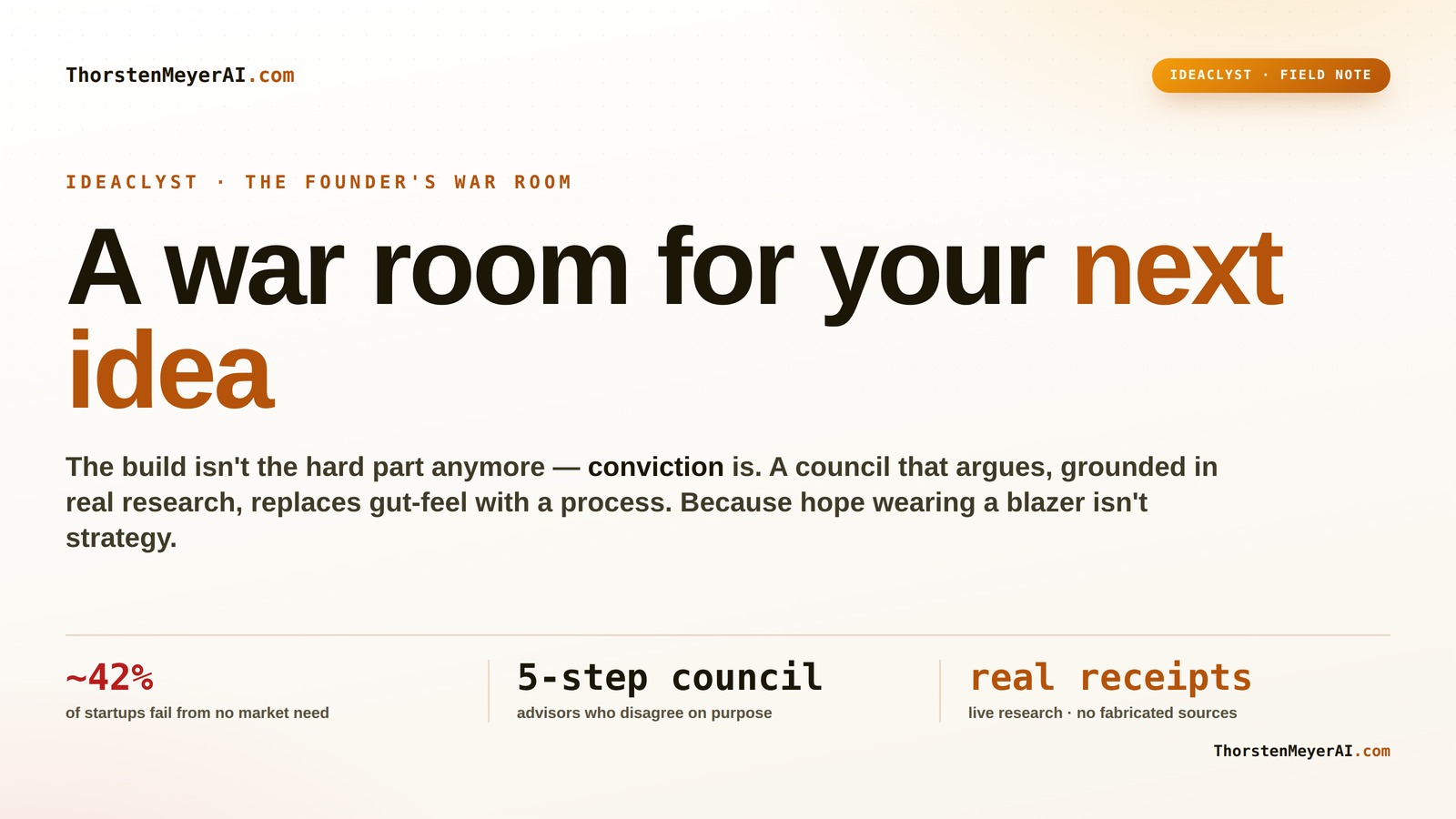
A war room for your next idea
The build isn’t the hard part anymore — conviction is. Knowing which idea deserves the next six months, and being able to defend it. Most founders answer with gut feel and optimistic math. That’s hope wearing a blazer. IdeaClyst replaces it with a process.
The most expensive decision is what to build
The single most valuable thing a tool can do is talk you out of the wrong six months. The numbers make the case better than any pitch.
Three tools in one — on your own machine
Strip away the framing and IdeaClyst is three things at once, all running locally with nothing leaving your laptop.
An AI council
Pressure-tests an idea you bring it — advisors who argue on purpose.
A discovery engine
Finds ideas you didn’t know to look for by hunting real demand signals.
A founder’s workspace
Carries winners from “interesting” all the way to “ready to build.”
Advisors who disagree on purpose
Not one confident, agreeable answer — a structured five-step deliberation where models play different roles and turn on their own work. The disagreement is the feature.
The five-step deliberation
A council that leads with the bad news surfaces the objections you’d otherwise find the expensive way, on month five.
Product strategy
Who’s it for, what’s the wedge, why now, what’s the business model.
Technical architecture
What would it actually take to build — and where’s the risk.
Critique pass
The council turns on its own work. Where’s the hand-waving? What kills this?
Second, independent critique
A different voice, a different angle — so blind spots don’t survive.
Final synthesis
Everything into one coherent founder packet: strategy, architecture, validation, plan.
When IdeaClyst cites a source, it actually fetched it
The hard departure from “ask an AI what it thinks of my startup.” It runs in a strict, real-data-only mode — if it can’t gather genuine evidence, it says so plainly rather than inventing a plausible paragraph.
Confidence with receipts
No fabricated statistics, no imaginary competitors, no made-up citations. The packet survives a skeptical co-founder or a sharp investor because the reasoning has receipts.
Market research first
Scouts the landscape before the council reasons about anything.
Competitor read
Real positioning, pricing signals, feature claims — differentiation vs. reality.
Validation with links
Not “talk to customers” — concrete signals & sources you can click.
From the blank page to build-ready
Evaluation is half the problem; the blank page is the other half. And a plan is worthless if it dies in a tab you never reopen.
Bring a space, not an idea
“AI for accountants,” “tools for indie game studios” — plus your goal and real capacity. It hunts demand signals across HN, Reddit, Product Hunt, GitHub, pricing pages.
- An honest market read — leads with the bad news when a space is hard
- An opportunity map — high pain, thin competition
- Ranked candidates — wedge, who pays, effort, risk, confidence
- each with KILL CRITERIA — when to walk away
A home and a forward path
Every promising idea gets carried forward, with every artifact in plain files on your disk.
- Validation tooling — sprint board, interview list, evidence browser
- Founder profile — a personal-fit lens; same discovery, different advice
- Build workspaces — funnel, personas, landing draft, version history
- “Build this idea” → a PRD + task queue, ready for a coding agent
Key Takeaways
- A digital war room centralizes idea development, making it easier to visualize progress and catch issues early.
- IdeaClyst’s structured AI council stages five deliberate steps—strategy, architecture, critique, second critique, synthesis—to rigorously test ideas.
- Grounding ideas in real-time, live web research prevents reliance on vague vibes and supports evidence-based decisions.
- Local-first design keeps your sensitive ideas private and under full control, avoiding data leaks and third-party access.
- Turning ideas into actionable plans is simple with organized Markdown documents, version control, and a clear blueprint.
private AI idea development software
As an affiliate, we earn on qualifying purchases.
As an affiliate, we earn on qualifying purchases.
Why a Digital War Room Is Your Secret Weapon
A war room isn’t just a fancy name for a meeting space. It’s a dedicated hub where your team gathers to focus, visualize, and strategize. Digital or physical, its power lies in making work visible and keeping everyone aligned. Think of it as your idea’s command center—where every hypothesis, critique, and plan lives. Learn more about building effective war rooms.
For founders, this means fewer lost hours chasing dead-end ideas. Instead, you get a clear picture of what’s promising—and what’s not—based on real discussion, not just gut feelings. IdeaClyst takes this concept online, giving you a private, flexible space to refine ideas without distractions or data leaks.
collaborative startup war room platform
As an affiliate, we earn on qualifying purchases.
As an affiliate, we earn on qualifying purchases.
How IdeaClyst Turns Your Idea Into a Battle-Tested Plan
Imagine bringing your half-baked idea into a virtual roundtable. IdeaClyst’s AI council stages five deliberate steps:
- Strategy: Who’s this for? Why now? What’s the business model?
- Architecture: What’s needed to build it? What could go wrong?
- Critique: What assumptions are shaky? Where’s the risk?
- Second Critique: A fresh set of eyes to catch what was missed.
- Synthesis: A final, clear plan ready for action.
This structured debate surfaces objections you might overlook, saving months of wasted effort. It’s like having a panel of expert advisors, all on your laptop, pushing your idea to its strongest form.
As an affiliate, we earn on qualifying purchases.
Why Grounding Ideas in Real Research Matters — And How IdeaClyst Does It
Many AI tools just give you vibes—”market growing,” “competitive landscape fragmented.” Not helpful when you’re trying to make a real bet. IdeaClyst goes a step further: it pulls in live web data and research to back up every claim. This means your strategy isn’t based on guesswork, but on current, verified facts.
For example, instead of assuming a market is booming, it scans recent news, reports, and data to confirm whether the opportunity still exists. That’s what makes IdeaClyst more than just another AI chat: it’s a research-backed, grounded decision-making partner.
As an affiliate, we earn on qualifying purchases.
Keep Your Ideas Private and Under Your Control with Local-First Design
Privacy isn’t just a buzzword for founders. It’s critical. IdeaClyst runs entirely on your machine, with no cloud account or API keys required. All your ideas, critiques, and roadmaps stay on your disk, stored as plain files. That means no data leaks, no third-party access, and full control.
Imagine working late at night, refining your startup plan, without worrying about your data floating around in the cloud. It’s open source under the MIT license, so you can customize, audit, and trust your tools. For founders who value ownership and security, this local-first approach is a game-changer.
Using IdeaClyst to Build a Real, Actionable Roadmap
Ideas are just words until you turn them into action. IdeaClyst’s final output is a comprehensive Markdown founder packet—strategy, architecture, critiques, validation plans—all organized in a clear, version-controlled document. It’s a living blueprint you can update, share, and reference at any time.
For instance, after a week of structured debate, your team might have a validated plan ready to pitch to investors or start building. The key is that everything lives on your own machine, integrated seamlessly with your workflow.
Making Your Idea War Room Visible and Collaborative
Visibility is everything. Whether physical or digital, your war room should be in a spot where everyone can see progress, add ideas, and challenge assumptions. In the digital world, this means clear folders, Markdown files, and organized critiques everyone can access.
For example, a startup might keep the IdeaClyst folder open on a shared server, with regular updates from team members. This transparency keeps momentum high and reduces miscommunication, making the entire team feel invested and aligned.
Practical Tips for Setting Up Your Own Idea War Room
Ready to create your own? Here are five practical steps:
- Choose a structure: Decide if you want a simple folder system or a more elaborate Markdown setup.
- Gather tools: Use a local text editor, version control, and research plugins to keep everything in one place.
- Define roles: Who critiques, who strategizes, who researches?
- Schedule reviews: Set regular check-ins to update, challenge, and synthesize ideas.
- Stay flexible: Be ready to reconfigure your setup as your project evolves.
Is Your Startup Ready for an IdeaClyst-Style War Room?
If you’re making high-stakes decisions or juggling multiple ideas, a dedicated war room can boost clarity and confidence. Small teams and solo founders can use it to prioritize, validate, and refine ideas without leaking data or losing control.
Think of it as your secret weapon—an organized, private space that helps you cut through the noise and focus on what truly matters. If that sounds appealing, it might be time to set up your own idea war room with tools like IdeaClyst.
Frequently Asked Questions
What exactly is a war room?
A war room is a dedicated space—physical or digital—where teams gather to focus on a project, visualize progress, debate ideas, and make decisions. It’s like a command center for strategic work.How is a digital war room different from a regular meeting room?
A digital war room is a centralized, organized space on your computer where all ideas, critiques, and plans are stored, versioned, and accessible anytime. It promotes ongoing collaboration without physical limitations or data leaks.Why should I use IdeaClyst for my startup?
Because it helps you rigorously test and validate ideas with a structured AI council grounded in real research, all while keeping your data private. It reduces wasted effort and boosts confidence before building.Can I really keep all my ideas on my own machine?
Yes. IdeaClyst is designed as a local-first tool. Your ideas, critiques, and plans stay on your disk, giving you full control and eliminating concerns about data privacy or security.How often should I update my war room?
Regular updates—weekly or bi-weekly—keep ideas fresh and discussions relevant. Set recurring review sessions to challenge assumptions, add new insights, and synthesize progress.Conclusion
Creating a war room for your ideas isn’t just a fancy concept—it’s a practical move for smarter, faster decision-making. With tools like IdeaClyst, you turn fuzzy concepts into validated, actionable plans—all while keeping your data private and your team aligned.
Your next big breakthrough starts with a dedicated space. Why not make it a war room that works as hard as you do?
Fall Picks
fall essentials
As an affiliate, we earn on qualifying purchases.