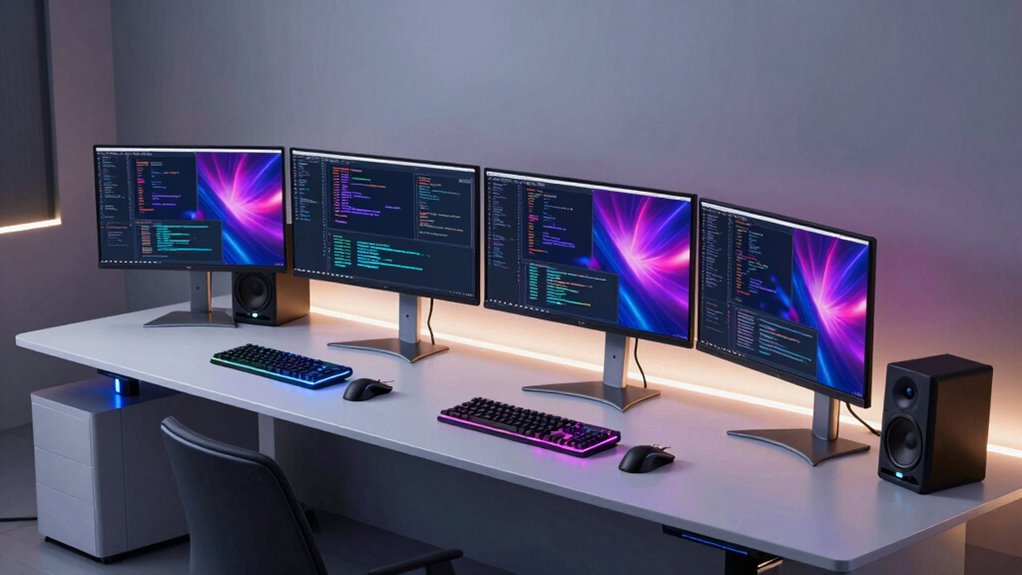

A high-performance desktop PC for coding should keep builds, virtual machines, and everyday tools responsive without paying for hardware your projects will not use. I rank the OmniDesk M03 as the best overall on paper, thanks to its Core Ultra 7 265, 64GB of memory, and 4TB SSD. The Dell Tower with 64GB and 4TB is a strong fit for developers who also want an RTX 5060, while the HP OmniDesk offers a simpler starting point with a Ryzen 7 8700G and bundled accessories. The main tradeoffs are memory and storage headroom, graphics capability, size, and how much configuration you actually need. Read on for the full comparison and guidance by workload.

Get the latest gadgets delivered free — and shop member deals
- Fast, free delivery on millions of items
- Access to Prime Big Deal Days deals on October 6–7
- Prime Video, Amazon Music and more included
Complete the kit



Key Takeaways
- OmniDesk M03 leads for CPU-focused work: its listed 64GB RAM and 4TB SSD provide room for multiple tools, local services, and large project files, without a discrete GPU in the listed configuration.
- The Dell 64GB/4TB configuration is the most balanced listed option for GPU-aware workflows: it pairs the same Core Ultra 7 265F family with an RTX 5060, but its larger configuration may be more than a typical editor-and-build workflow needs.
- The two 32GB/1TB Dell listings appear very similar: compare their exact model numbers and included software before choosing; the supplied specs do not show a meaningful performance distinction.
- The HP and ASUS start with 16GB RAM: that can suit learning and lighter projects, but leaves less room for containers, emulators, and virtual machines than the 32GB and 64GB systems.
- The gaming systems are the graphics-focused choices: MSI Codex Z2 and Alienware Aurora may suit GPU-intensive development, but their supplied listings lack enough configuration detail for a precise comparison with the better-specified desktops.
| HP OmniDesk Desktop PC with AMD Ryzen 7 8700G, 16GB RAM, 1TB SSD, Windows 11 Pro, Wireless Keyboard & Mouse, and 8-in-1 Hub |  | Best for Coding on Integrated Graphics | Processor: AMD Ryzen 7 8700G, 8 cores, 16 threads, up to 5.1GHz | Graphics: Integrated AMD Radeon 780M | Memory: 16GB DDR5 | VIEW ON AMAZON | See Our Full Breakdown |
| MSI Codex Z2 Gaming Desktop |  | Best for GPU-Accelerated Development | Processor: AMD Ryzen 7 8700F, 8 cores, 16 threads, up to 5.0GHz | Graphics: NVIDIA GeForce RTX 5070 | Memory: 32GB DDR5 | VIEW ON AMAZON | See Our Full Breakdown |
| OmniDesk M03 Business Desktop PC with Intel Core Ultra 7 265, 64GB DDR5 RAM, 4TB SSD, Windows 11 |  | Best for Large Builds and Heavy Multitasking | Processor: Intel Core Ultra 7 265, 20 cores, 20 threads | Memory: 64GB DDR5-6400 dual channel | Storage: 4TB PCIe Gen5 NVMe SSD plus 1TB HDD | VIEW ON AMAZON | See Our Full Breakdown |
| Dell Tower Desktop Computer with Intel Core Ultra 7 265F, NVIDIA GeForce RTX 5060, 32GB DDR5, 1TB SSD |  | Best Balanced Tower for Coding and GPU Work | Processor: Intel Core Ultra 7 265F, 20 cores | Graphics: NVIDIA GeForce RTX 5060, 8GB GDDR7 | Memory: 32GB DDR5-5600 | VIEW ON AMAZON | See Our Full Breakdown |
| Dell Tower Desktop Computer with Intel Ultra 7 265F, NVIDIA RTX 5060, 32GB DDR5 RAM, 1TB SSD |  | Best for a Ready-to-Connect Setup | Processor: Intel Ultra 7 265F, 20 cores | Graphics: NVIDIA GeForce RTX 5060, 8GB GDDR7 | Memory: 32GB DDR5 | VIEW ON AMAZON | See Our Full Breakdown |
| Dell Tower Desktop PC with Intel Core Ultra 7 265F, NVIDIA RTX 5060, 64GB DDR5 RAM, 4TB SSD, Windows 11 Pro |  | Best for Large Coding Projects | Processor: Intel Core Ultra 7 265F, 20 cores, up to 5.3 GHz | Graphics: NVIDIA GeForce RTX 5060, 8GB GDDR7 | Memory: 64GB DDR5, 5600 MT/s | VIEW ON AMAZON | See Our Full Breakdown |
| ASUS V500 Mini Tower Desktop PC (15L), Intel Core i7-13620H, 16GB DDR5 RAM, 1TB SSD, Windows 11 Home, Gray |  | Best Compact Starter Tower | Processor: Intel Core i7-13620H, 10 cores, 16 threads, up to 4.9 GHz | Graphics: Intel UHD Graphics | Memory: 16GB DDR5 | VIEW ON AMAZON | See Our Full Breakdown |
| Alienware Aurora Gaming Desktop, RTX 5070, Intel Core Ultra 7 265F |  | Best for GPU-Heavy Development | Processor: Intel Core Ultra 7 265F | Graphics: NVIDIA GeForce RTX 5070, Blackwell architecture | Finish: Matte basalt black | VIEW ON AMAZON | See Our Full Breakdown |
| high performance desktop pc for coding | Processor | Graphics | Memory | Storage |
|---|---|---|---|---|
| HP OmniDesk Desktop PC with AM | AMD Ryzen 7 8700G, 8 cores, 16 threads, up to 5.1GHz | Integrated AMD Radeon 780M | 16GB DDR5 | 1TB PCIe 4.0 SSD |
| MSI Codex Z2 Gaming Desktop | AMD Ryzen 7 8700F, 8 cores, 16 threads, up to 5.0GHz | NVIDIA GeForce RTX 5070 | 32GB DDR5 | 2TB SSD |
| OmniDesk M03 Business Desktop | Intel Core Ultra 7 265, 20 cores, 20 threads | — | 64GB DDR5-6400 dual channel | 4TB PCIe Gen5 NVMe SSD plus 1TB HDD |
| Dell Tower Desktop Computer wi | Intel Core Ultra 7 265F, 20 cores | NVIDIA GeForce RTX 5060, 8GB GDDR7 | 32GB DDR5-5600 | 1TB PCIe NVMe SSD |
| Dell Tower Desktop Computer wi | Intel Ultra 7 265F, 20 cores | NVIDIA GeForce RTX 5060, 8GB GDDR7 | 32GB DDR5 | 1TB M.2 PCIe NVMe SSD |
| Dell Tower Desktop PC with Int | Intel Core Ultra 7 265F, 20 cores, up to 5.3 GHz | NVIDIA GeForce RTX 5060, 8GB GDDR7 | 64GB DDR5, 5600 MT/s | 4TB PCIe NVMe SSD |
| ASUS V500 Mini Tower Desktop P | Intel Core i7-13620H, 10 cores, 16 threads, up to 4.9 GHz | Intel UHD Graphics | 16GB DDR5 | 1TB PCIe SSD |
| Alienware Aurora Gaming Deskto | Intel Core Ultra 7 265F | NVIDIA GeForce RTX 5070, Blackwell architecture | — | — |
More Details on Our Top Picks
HP OmniDesk Desktop PC with AMD Ryzen 7 8700G, 16GB RAM, 1TB SSD, Windows 11 Pro, Wireless Keyboard & Mouse, and 8-in-1 Hub
The HP OmniDesk suits developers who want a capable coding desktop with a ready-to-use accessory bundle. Its 8-core Ryzen 7 8700G, 16GB of DDR5 memory, and 1TB PCIe 4.0 SSD cover everyday IDE work, browser tabs, and local development without needing a separate graphics card. Compared with the MSI Codex Z2, it gives up substantial graphics power and half the memory, but its Windows 11 Pro license and included hub make it a better fit for a straightforward office setup. The Radeon 780M can handle light graphics work, though it is not a substitute for a discrete GPU when running demanding 3D workloads. Its 16GB RAM can also constrain large projects or multiple containers, and the prebuilt office design offers limited upgrade flexibility.
Pros:- Eight-core Ryzen 7 processor supports responsive IDE and multitasking use
- 1TB PCIe 4.0 SSD provides fast project and application loading
- Windows 11 Pro is included
- Wireless keyboard, mouse, and 8-in-1 hub simplify initial setup
Cons:- 16GB of memory is modest for large codebases, containers, or virtual machines
- Integrated Radeon 780M is less capable for GPU-intensive work than the MSI Codex Z2 or Dell RTX 5060 towers
- Office desktop design may restrict future upgrades
Best for: Windows developers building web, business, or education projects who want Pro features, integrated graphics, and included peripherals.
Not ideal for: Developers running several virtual machines, large local AI models, or GPU-heavy workloads; 16GB RAM and integrated graphics may become limiting.
- Processor:AMD Ryzen 7 8700G, 8 cores, 16 threads, up to 5.1GHz
- Graphics:Integrated AMD Radeon 780M
- Memory:16GB DDR5
- Storage:1TB PCIe 4.0 SSD
- Operating system:Windows 11 Pro
- Connectivity:Wi-Fi 6, Bluetooth, Ethernet
- Display outputs:HDMI, DisplayPort 1.4
- Included accessories:Wireless keyboard, wireless mouse, PLUSERA 8-in-1 hub
Our verdict“Choose the HP OmniDesk for everyday Windows development with Pro features and a useful accessory bundle, provided 16GB RAM and integrated graphics fit your workload.”
MSI Codex Z2 Gaming Desktop
The MSI Codex Z2 is the strongest fit here for coding workflows that benefit from a capable graphics card, such as GPU compute, graphics development, or local experimentation with supported AI tools. Its RTX 5070 gives it a clear graphics advantage over the Dell towers with RTX 5060, while the 32GB of DDR5 RAM and 2TB SSD leave useful room for tools, datasets, and active projects. The eight-core Ryzen 7 8700F keeps general development work well supported, though the lineup’s OmniDesk M03 supplies twice the memory and a larger SSD for memory-heavy builds. The four-fan cooling setup is suited to sustained loads, but the available details do not specify port layout or expansion options. Windows 11 Home may also be a less natural match for buyers who specifically need Pro features.
Pros:- RTX 5070 supports demanding GPU development and graphics workloads
- 32GB DDR5 memory suits multitasking and substantial development environments
- 2TB SSD provides room for projects, datasets, and development tools
- Four system fans support airflow during sustained workloads
Cons:- Windows 11 Home lacks the Pro edition included with the HP OmniDesk
- Has less memory and SSD capacity than the OmniDesk M03
- Port configuration and expansion details are not provided
Best for: Developers working with GPU compute, graphics engines, or local AI experimentation who also want ample memory and project storage.
Not ideal for: Business users who require Windows 11 Pro, or developers whose main constraint is memory capacity for large builds and virtual machines.
- Processor:AMD Ryzen 7 8700F, 8 cores, 16 threads, up to 5.0GHz
- Graphics:NVIDIA GeForce RTX 5070
- Memory:32GB DDR5
- Storage:2TB SSD
- Operating system:Windows 11 Home
- Cooling:Four system fans: three front, one rear, with ARGB air cooler
- Lighting:Customizable RGB via MSI Center software
Our verdict“Pick the MSI Codex Z2 when GPU capability matters more to your development work than Windows Pro or the M03’s larger memory and storage configuration.”
OmniDesk M03 Business Desktop PC with Intel Core Ultra 7 265, 64GB DDR5 RAM, 4TB SSD, Windows 11
For developers who routinely keep large projects, databases, and several tools open at once, the OmniDesk M03 leads with 64GB DDR5 memory and a 4TB Gen5 NVMe SSD. Its 20-core Core Ultra 7 265 offers a broader multitasking profile than the eight-core CPUs in the HP OmniDesk and MSI Codex Z2, while dual 4K display support can simplify a multi-window coding setup. The listed 1TB HDD adds capacity, but it is slower than the primary SSD for active files. This is also the only option here with no dedicated graphics card specified, so the RTX-equipped Dell towers are a better match for GPU-intensive development. Windows 11 Home and the sizeable tower footprint may not suit every business environment or desk.
Pros:- 20-core Core Ultra 7 processor is suited to parallel workloads
- 64GB DDR5 memory supports heavy multitasking and large development environments
- 4TB Gen5 NVMe SSD offers substantial fast storage for active projects
- Supports up to two 4K displays and includes Wi-Fi 6 and 2.5GbE
Cons:- No discrete graphics card is specified, unlike the MSI Codex Z2 and Dell RTX 5060 models
- Secondary 1TB HDD is slower than the main NVMe SSD
- Windows 11 Home and 14.5-inch height may not fit some business or desk setups
Best for: Developers compiling large projects, running multiple containers or local services, and keeping extensive work files on one desktop.
Not ideal for: GPU developers, users needing Windows 11 Pro, or anyone with limited desk space; no discrete GPU is listed and the chassis is relatively tall.
- Processor:Intel Core Ultra 7 265, 20 cores, 20 threads
- Memory:64GB DDR5-6400 dual channel
- Storage:4TB PCIe Gen5 NVMe SSD plus 1TB HDD
- Operating system:Windows 11 Home
- Graphics and displays:Dual monitor support, up to two 4K displays; no discrete GPU specified
- Connectivity:Wi-Fi 6, Bluetooth 5.3, 2.5GbE Ethernet
- Ports:2 HDMI 2.1, 1 DisplayPort 2.1, 6 USB 3.2 Gen2, 2 USB-C
- Dimensions:14.5 × 6.5 × 13.8 inches
Our verdict“Choose the OmniDesk M03 for CPU-heavy development and large local workloads when memory and SSD capacity matter more than discrete GPU performance.”
Dell Tower Desktop Computer with Intel Core Ultra 7 265F, NVIDIA GeForce RTX 5060, 32GB DDR5, 1TB SSD
The Dell Tower with RTX 5060 balances a 20-core processor with a discrete GPU, making it a versatile choice for developers who alternate between compiling, multitasking, and graphics-enabled tools. Its 32GB DDR5 RAM and 1TB NVMe SSD provide a stronger starting point for demanding work than the HP OmniDesk’s 16GB configuration. Compared with the MSI Codex Z2, this Dell has an RTX 5060 rather than an RTX 5070 and half the listed SSD capacity, but its Intel Core Ultra 7 265F brings more listed CPU cores than the MSI’s Ryzen 7 8700F. The 8GB graphics memory and discrete card support GPU workloads, though the product data leaves port counts and upgrade details unclear. The tower also takes more space than a compact desktop.
Pros:- 20-core Core Ultra 7 265F supports substantial parallel workloads
- RTX 5060 with 8GB GDDR7 enables GPU-accelerated development
- 32GB DDR5 memory supports a busy IDE and development tool stack
- Wi-Fi 6, Bluetooth 5.4, and Gigabit Ethernet offer flexible connectivity
Cons:- RTX 5060 is a step below the MSI Codex Z2’s RTX 5070
- 1TB SSD provides less space than the MSI Codex Z2 and OmniDesk M03
- Tower form factor needs more room, and detailed port counts are unspecified
Best for: Developers who need a discrete GPU for graphics or compute tasks alongside parallel CPU work and 32GB of memory.
Not ideal for: Buyers who prioritize maximum GPU performance or large built-in storage; the MSI Codex Z2 lists a stronger graphics card and 2TB SSD.
- Processor:Intel Core Ultra 7 265F, 20 cores
- Graphics:NVIDIA GeForce RTX 5060, 8GB GDDR7
- Memory:32GB DDR5-5600
- Storage:1TB PCIe NVMe SSD
- Connectivity:Wi-Fi 6, Bluetooth 5.4, Gigabit Ethernet
- Video outputs:HDMI 2.1, DisplayPort 1.4a
- Form factor:Tower
Our verdict“Choose this Dell for a balanced mix of many CPU cores, 32GB RAM, and discrete graphics when the MSI’s higher GPU tier and larger SSD are not priorities.”
Dell Tower Desktop Computer with Intel Ultra 7 265F, NVIDIA RTX 5060, 32GB DDR5 RAM, 1TB SSD
This Dell RTX 5060 tower pairs a 20-core Intel Ultra 7 265F with 32GB DDR5 RAM and a 1TB NVMe SSD, a configuration suited to coding alongside GPU-enabled creative or development work. Its listed eight USB ports, USB-C, and SD card reader make it easier to attach a broad mix of peripherals and removable media than the less-detailed port listing for the other Dell RTX 5060 tower. The two Dell models otherwise share much of their core specification, so buyers should focus on this model’s documented connections and included wired keyboard and mouse. Its 360W power supply may constrain future component upgrades, and it has the same 1TB storage and 32GB memory as the other Dell. Compared with the MSI Codex Z2, it offers less GPU tier and SSD capacity.
Pros:- 20-core Intel processor and RTX 5060 cover CPU and GPU development tasks
- 32GB DDR5 RAM and M.2 NVMe storage support responsive daily workflows
- Eight USB ports, including USB-C, plus an SD card reader
- Wired keyboard and mouse are included
Cons:- 360W power supply may limit higher-power future upgrades
- 1TB SSD and 32GB RAM are less generous than the OmniDesk M03 configuration
- RTX 5060 is below the MSI Codex Z2’s RTX 5070
Best for: Developers who want a discrete-GPU desktop with a documented range of ports, SD card access, and basic wired peripherals included.
Not ideal for: Buyers planning major graphics or power supply upgrades, or those needing more than 32GB RAM and 1TB SSD without later expansion.
- Processor:Intel Ultra 7 265F, 20 cores
- Graphics:NVIDIA GeForce RTX 5060, 8GB GDDR7
- Memory:32GB DDR5
- Storage:1TB M.2 PCIe NVMe SSD
- Power supply:360W
- Connectivity:Wi-Fi 6, Bluetooth 5.4
- Ports and readers:HDMI 2.1, DisplayPort 1.4a, 8 USB ports including USB-C, SD card reader
- Included accessories:Wired keyboard, wired mouse, power cable, quick-start guide
- Warranty:1-year official global warranty
Our verdict“Pick this Dell when its listed port selection, SD reader, and included peripherals suit your setup, while keeping its 360W supply in mind for future upgrades.”
Dell Tower Desktop PC with Intel Core Ultra 7 265F, NVIDIA RTX 5060, 64GB DDR5 RAM, 4TB SSD, Windows 11 Pro
For developers who keep several projects, containers, and creative tools on one machine, my pick here is the Dell Tower’s 64GB of DDR5 memory and 4TB NVMe SSD. That capacity gives it a clear productivity advantage over the Dell Tower with 32GB RAM and 1TB SSD, especially when local repositories, virtual machines, or datasets accumulate. Its 20-core Core Ultra 7 265F and RTX 5060 also suit parallel workloads and GPU-assisted tasks, though the 8GB graphics memory is a limit for larger models or demanding 3D work. The compact chassis is easier to fit than the Alienware Aurora, but the port mix includes only one USB-C and three USB-A 3.2 ports. I’d choose it for memory and storage headroom, not for the broadest high-speed connectivity.
Pros:- 64GB DDR5 supports memory-heavy development workflows and multitasking.
- 4TB NVMe SSD leaves room for large repositories, virtual machines, and local datasets.
- 20-core processor is suited to parallel builds and concurrent workloads.
- Compact tower footprint and Windows 11 Pro suit a business workstation setup.
Cons:- RTX 5060’s 8GB graphics memory may constrain larger GPU workloads.
- Only four listed USB 3.2 ports, including a single USB-C port.
- No optical drive.
Best for: Developers who run multiple virtual machines or containers and keep large local codebases, datasets, and build artifacts.
Not ideal for: GPU compute specialists or users with many fast peripherals, since the RTX 5060 has 8GB of graphics memory and high-speed USB ports are limited.
- Processor:Intel Core Ultra 7 265F, 20 cores, up to 5.3 GHz
- Graphics:NVIDIA GeForce RTX 5060, 8GB GDDR7
- Memory:64GB DDR5, 5600 MT/s
- Storage:4TB PCIe NVMe SSD
- Operating system:Windows 11 Pro
- Connectivity:Wi-Fi 6, Bluetooth 5.4, Gigabit Ethernet
- Ports:1 USB-C 3.2 Gen 1, 3 USB-A 3.2 Gen 1, 4 USB 2.0, 1 DisplayPort 1.4a, 1 HDMI 2.1
- Dimensions:11.54 × 6.06 × 12.77 inches
Our verdict“Choose this Dell when large projects and memory-intensive multitasking matter more than high-end GPU capacity or abundant fast USB ports.”
ASUS V500 Mini Tower Desktop PC (15L), Intel Core i7-13620H, 16GB DDR5 RAM, 1TB SSD, Windows 11 Home, Gray
The ASUS V500 is the compact, lower-spec option for coding that centers on everyday development rather than demanding local builds or graphics work. Its 10-core Core i7, 16GB of DDR5, and 1TB SSD can cover lightweight IDE use, coursework, and office tasks, while the included keyboard, mouse, and hub help a new setup get started. Against the Dell Tower with 64GB RAM and 4TB storage, it gives up substantial room for simultaneous tools, virtual machines, and project files. Its Intel UHD Graphics also make it a poor fit for GPU-heavy development. The listing says the factory seal was opened for upgrades, and warranty service comes from Smartisan Tech rather than ASUS. I’d put it on the shortlist for a space-conscious beginner who accepts those support and capacity tradeoffs.
Pros:- Compact 15L mini tower takes up less desk space than the Alienware Aurora.
- 10-core processor and DDR5 memory cover common coding and office workloads.
- USB-C, DisplayPort, HDMI, and Ethernet provide useful connection options.
- Keyboard, mouse, and 8-in-1 hub are included.
Cons:- 16GB RAM and 1TB storage offer less headroom than the Dell Tower with 64GB and 4TB.
- Intel UHD integrated graphics are unsuitable for demanding graphics workloads.
- Factory seal is opened for upgrades, with warranty service from Smartisan Tech.
Best for: Students and first-time developers working on coursework, web projects, and general office tasks in a small workspace.
Not ideal for: Developers running several virtual machines, large builds, or GPU-dependent tools, and buyers who require an unopened unit or ASUS-provided warranty.
- Processor:Intel Core i7-13620H, 10 cores, 16 threads, up to 4.9 GHz
- Graphics:Intel UHD Graphics
- Memory:16GB DDR5
- Storage:1TB PCIe SSD
- Operating system:Windows 11 Home
- Power supply:180W 80+ Bronze
- Connectivity:Wi-Fi 6, Bluetooth 5.4, Ethernet
- Ports:1 USB-C 3.2, 2 USB-A 3.2, 4 USB-A 2.0, HDMI 1.4, DisplayPort 1.4
- Dimensions and weight:13 × 6 × 13 inches; 13 lb
Our verdict“Pick the ASUS V500 for beginner or coursework coding in a compact setup, provided its opened packaging and third-party warranty fit your needs.”
Alienware Aurora Gaming Desktop, RTX 5070, Intel Core Ultra 7 265F
When coding overlaps with GPU-heavy creation, the Alienware Aurora has the strongest graphics card listed in this batch: an RTX 5070 paired with the Core Ultra 7 265F. That makes it the more fitting choice than the Dell Tower with RTX 5060 for graphics-oriented work, game development, or GPU-accelerated tools. The supplied details do not specify its memory or storage, though, so I can’t rank its capacity against the Dell’s known 64GB RAM and 4TB SSD. AlienFX lighting and the gaming chassis are welcome to buyers who want that style, but they add little to compiling code, and the larger case can be awkward on a crowded desk. A one-year onsite service warranty adds practical support. I’d favor it for GPU priorities, while checking configuration details before committing to a development workload.
Pros:- RTX 5070 is a higher-tier listed GPU than the RTX 5060 in the Dell Tower options.
- Core Ultra 7 265F supports multitasking alongside graphics workloads.
- One-year onsite service warranty offers in-person support.
- AlienFX zones allow customizable lighting.
Cons:- Large chassis can be difficult to place in a compact workspace.
- Provided product data does not specify RAM or storage capacity.
- Power use may rise during intensive workloads.
Best for: Game developers and creators who need a stronger listed GPU for graphics-oriented or GPU-accelerated work alongside coding.
Not ideal for: Developers focused on CPU builds, large local environments, or compact desk setups, especially if memory and storage capacity must be known before purchase.
- Processor:Intel Core Ultra 7 265F
- Graphics:NVIDIA GeForce RTX 5070, Blackwell architecture
- Finish:Matte basalt black
- Lighting:Customizable AlienFX zones with stadium lighting
- Service:1-year onsite service
- Software:Alienware Command Center
Our verdict“Choose the Aurora for GPU-focused coding and creation if its specific memory and storage configuration meets your project needs and you have room for its larger chassis.”

How We Picked
I ranked these desktops by how well their listed components support common coding workloads: compiling projects, running an IDE and browser together, using containers or virtual machines, storing repositories and development tools, and handling GPU-based tasks. I gave more weight to the CPU, memory, and storage combination than to gaming-oriented branding, since those parts shape day-to-day development for many buyers. I also considered the practical fit of a compact 15L tower, bundled accessories, and Windows editions where those details were supplied.
The OmniDesk M03 ranks first because its listed 64GB RAM and 4TB SSD offer substantial working room alongside a current Core Ultra 7 processor. The Dell 64GB/4TB model follows for buyers who need both that capacity and a discrete RTX 5060; the 32GB/1TB Dell listings offer a more restrained configuration, though their near-identical supplied specs make their ordering effectively a tie. HP and ASUS are easier entry points but start at 16GB, while MSI Codex Z2 and Alienware Aurora cannot be ranked as precisely because their supplied details omit memory and storage configurations. These rankings reflect the provided specifications, not independent performance testing.
| high performance desktop pc for coding | Graphics | Operating system | Connectivity |
|---|---|---|---|
| HP OmniDesk Desktop PC with AM | Integrated AMD Radeon 780M | Windows 11 Pro | Wi-Fi 6, Bluetooth, Ethernet |
| MSI Codex Z2 Gaming Desktop | NVIDIA GeForce RTX 5070 | Windows 11 Home | — |
| OmniDesk M03 Business Desktop | — | Windows 11 Home | Wi-Fi 6, Bluetooth 5.3, 2.5GbE Ethernet |
| Dell Tower Desktop Computer wi | NVIDIA GeForce RTX 5060, 8GB GDDR7 | — | Wi-Fi 6, Bluetooth 5.4, Gigabit Ethernet |
| Dell Tower Desktop Computer wi | NVIDIA GeForce RTX 5060, 8GB GDDR7 | — | Wi-Fi 6, Bluetooth 5.4 |
| Dell Tower Desktop PC with Int | NVIDIA GeForce RTX 5060, 8GB GDDR7 | Windows 11 Pro | Wi-Fi 6, Bluetooth 5.4, Gigabit Ethernet |
| ASUS V500 Mini Tower Desktop P | Intel UHD Graphics | Windows 11 Home | Wi-Fi 6, Bluetooth 5.4, Ethernet |
| Alienware Aurora Gaming Deskto | NVIDIA GeForce RTX 5070, Blackwell architecture | — | — |
Factors to Consider When Choosing High Performance Desktop Pc For Coding
Choosing a coding desktop starts with the work you expect it to do over the next few years, not with the biggest specification you can find. These factors help translate component choices into a setup that fits your tools, space, and upgrade plans.
Match Memory to Your Workflow
Memory use can climb quickly when an IDE, browser tabs, containers, databases, and emulators run together. For light web development or coursework, 16GB may be workable, but it gives you less room to keep several services open. Buyers using virtual machines, Android emulators, or larger container stacks should look for more capacity, with 32GB a more comfortable starting point and 64GB useful for heavier concurrent workloads. Avoid choosing by processor name alone if the system has too little RAM for your actual toolchain. Also check whether the memory is upgradeable and how many slots remain free. That detail can matter more than a small CPU difference when you plan to keep the desktop for years.
Prioritize the Right CPU, Not Just a Newer Label
Build speed depends on the project, compiler, and how much work can run in parallel, so a higher-end CPU can help with large builds and multiple simultaneous tasks. Many coding activities, such as editing, documentation, and running a local web server, do not need a gaming-class processor. Check independent benchmarks for the specific processor and software you use, since model names alone do not predict every workload. A desktop CPU can also differ from a similarly named mobile chip in sustained performance and power behavior. If your work is mostly single-threaded, memory and a responsive SSD may improve the experience more than spending extra on CPU cores. Reserve the largest CPU investment for repeated builds, heavy simulations, or several demanding development environments running at once.
Decide Whether You Need a Discrete GPU
Most programming does not require a powerful graphics card, and integrated graphics can handle code editors, terminals, and ordinary multi-monitor use when the system supports your display setup. A discrete GPU becomes more relevant for machine learning experimentation, graphics programming, game development, GPU rendering, or local workloads that specifically use GPU acceleration. Before paying for one, check the framework’s hardware support and whether your intended tasks can run locally or are better suited to cloud resources. Graphics cards add heat, power draw, and physical space requirements, which can affect noise and future upgrades. A gaming desktop’s GPU may be useful, but gaming branding by itself does not make a computer better for compiling code. Match the card to a real GPU workload you expect to run.
Size Storage for Projects and Local Environments
SSD capacity goes to more than source files: development tools, SDKs, container images, virtual machine disks, datasets, and build artifacts all take space. A 1TB drive can be enough for a focused setup, while several large projects or local environments can make additional capacity useful. Consider whether the desktop has a second M.2 slot or room for another drive before paying for capacity you may never fill. Faster storage helps with launches, file access, and some build workflows, but capacity and a sensible backup plan matter too. Keep a separate backup of repositories and important work; a large internal SSD is not a backup. Check whether the supplied drive is replaceable and whether opening the case affects support coverage.
Check Upgradeability, Cooling, and Support
A desktop can offer a longer useful life when you can add memory or storage later, but small or proprietary cases may limit those options. Look for details on standard memory slots, drive bays, power supply capacity, and graphics card clearance before assuming a tower is easy to modify. Cooling also matters for sustained compiling: a CPU that gets too hot may slow down during long workloads, and restrictive airflow can make fans louder. Manufacturer support, warranty terms, and access to replacement parts influence how practical repairs will be. Prebuilt systems vary widely in these areas, so seek a service manual or internal layout before purchase. If you do not plan to upgrade, a well-balanced factory configuration may be a better fit than a case chosen for hypothetical changes.
Choose an Operating System That Fits Your Toolchain
Windows desktops can run a broad range of development tools, and Windows Subsystem for Linux can support many Linux-oriented workflows. Some drivers, container setups, deployment tools, and production environments still behave differently across Windows, Linux, and macOS. Verify that your required languages, IDEs, security tools, and virtualization software work with the included operating system edition. Windows Pro adds business-oriented management and security features that some developers or workplaces need, but many individual coding setups can use Home. If you rely on a Linux-first toolchain, check whether dual booting or a separate Linux installation is practical on the specific machine. Sorting this out early can prevent buying capable hardware that complicates your daily workflow.
Frequently Asked Questions
Is 16GB of RAM enough for programming, or should I choose 32GB?
For learning, lightweight web development, and one main IDE, 16GB can be sufficient. It becomes limiting sooner when you run containers, virtual machines, emulators, large browser sessions, or local databases alongside your editor. The 32GB systems in this roundup leave more room for those combined workloads without jumping to the 64GB configurations. If the desktop allows memory upgrades, 16GB can serve as a starting point, but check the slot layout and supported capacity first. Choose 64GB when your work regularly needs several memory-heavy environments at once.
Should I choose the Dell with an RTX 5060 for coding?
Choose an RTX 5060 if your coding includes GPU-accelerated machine learning, game development, graphics work, or another task that benefits from CUDA or similar GPU support. For ordinary software development, a discrete graphics card may add cost, heat, and power use without making editing or compilation noticeably better. The Dell 32GB/1TB listings provide a more modest configuration than the 64GB/4TB Dell while retaining the listed GPU. Check the requirements of your actual framework and target applications before deciding. If your GPU work is occasional, remote or cloud compute may be a better fit than buying a card for every development task.
How should I choose between the two Dell 32GB/1TB listings?
The supplied specifications show both with an Intel Core Ultra 7 265F, RTX 5060, 32GB DDR5 RAM, and 1TB SSD, so they do not establish a clear performance difference. Compare the exact product or model numbers and confirm that the memory, storage, graphics card, and operating system match the listing you intend to buy. Check the included warranty, case, power supply, and available upgrade slots as well, since those details can differ even when headline specs look alike. If one configuration offers better support or easier expansion, that can settle the choice for a long-term workstation. Do not infer that an ambiguous title means the systems are identical in every respect.
Is the 64GB RAM and 4TB SSD configuration worth choosing for a coding desktop?
That capacity is useful if you keep multiple virtual machines, large datasets, container images, or several sizeable projects on the machine. It can also reduce the need to manage local storage closely. A developer running one IDE, a browser, and a few lightweight services may not make full use of either specification. Consider whether you could add memory or another SSD later, then compare that path with buying the larger factory configuration now. The OmniDesk M03 pairs those capacities with a Core Ultra 7 but has no discrete GPU listed, while the Dell 64GB/4TB option adds an RTX 5060 for GPU-focused tasks.
Can I use a compact or gaming desktop as a development workstation?
Yes, if its ports, operating system, cooling, and component configuration fit your work. The ASUS V500’s 15L case may suit a smaller desk, but its listed 16GB RAM leaves less headroom for heavy multitasking, and compact layouts can constrain upgrades. Gaming desktops such as the MSI Codex Z2 and Alienware Aurora may suit GPU-heavy development, but their supplied listings do not state enough memory and storage detail to judge their coding value precisely. Confirm those configurations, fan noise, and sustained cooling before choosing one as a workstation. For everyday coding, a gaming label is less useful than a balanced CPU, adequate RAM, and the right storage.
Conclusion
I would choose the OmniDesk M03 as the best overall for CPU-focused development that benefits from 64GB RAM and 4TB storage. For best value among the clearly specified configurations, the Dell 32GB/1TB models offer a more measured balance, though I would compare their exact model details before picking between them. The Dell 64GB/4TB is the best premium fit for developers who also need its RTX 5060, while the HP OmniDesk is the best beginner-friendly starting point with bundled accessories and a capable listed Ryzen 7. Choose the ASUS V500 for a compact footprint if its 16GB memory suits your workload, or consider MSI Codex Z2 and Alienware Aurora for GPU-oriented work after confirming their full configurations. Your best match depends on whether your daily bottleneck is simultaneous workloads, local storage, graphics acceleration, or desk space.
Halloween Picks
halloween
As an affiliate, we earn on qualifying purchases.