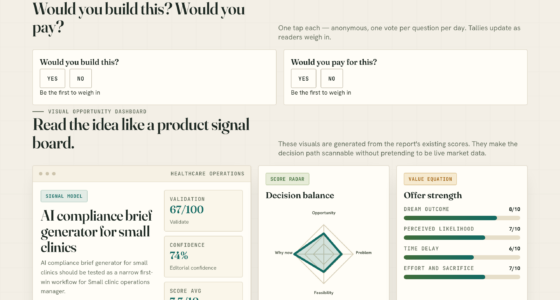

📊 Full opportunity report: Capital: The Lever Beneath the Levers on ThorstenMeyerAI.com — validation score, market gap, and execution plan.
TL;DR
Major AI companies are raising billions through public listings, transferring risk from private investors to the public market. The capital cycle is creating circular dependencies and vulnerabilities that could impact the broader economy.
In June 2026, SpaceX’s xAI listed on the Nasdaq at a valuation near $1.77 trillion, with oversubscription and a surge past $2 trillion in early trading, marking a historic public funding event for AI. Simultaneously, Anthropic and OpenAI are preparing for public listings valued at hundreds of billions, transferring large amounts of risk from private investors to the market. This marks a pivotal moment in the AI funding cycle, where capital becomes the final lever shaping the industry’s future.
On June 12, SpaceX, which now includes xAI, listed on the Nasdaq with a valuation close to $1.77 trillion, surpassing $2 trillion briefly in early trading. The offering was heavily oversubscribed, with about 30% of shares reserved for retail investors, indicating strong demand. Meanwhile, Anthropic confidentially filed for a $965 billion valuation, and OpenAI is reportedly preparing for a fall IPO valued between $730 billion and $850 billion. These moves collectively represent roughly $4 trillion in private value transitioning to public markets within 18 months, according to Bank of America.
Analysts describe this as a large-scale transfer of risk, with many early investors, including more than 600 former OpenAI staff, having already sold about $6.6 billion in stock. This pattern suggests a significant shift of risk from private insiders to the broader market, raising questions about the sustainability of such valuations and the underlying demand.
Capital: The Lever Beneath the Levers
Every chokepoint costs money — so whoever can fund the buildout decides who builds at all. In 2026 the bill came due in public: a trillion-dollar IPO wave, financed by a circle of firms paying each other, now sold to everyone else.
The meta-chokepoint: it gates the other five, because you can’t build any of them without clearing the capital bar. A synchronized machine has no natural brake — no one can slow first — and the IPO wave moves the risk to the public as insiders take gains. The hedge is solvency that doesn’t depend on the music playing: sane burn, own what’s cheap, self-host where you can.
Implications of Capital Concentration in AI Funding
This surge in public listings and the transfer of risk to the public markets highlights how capital is central to AI’s expansion, but also exposes systemic vulnerabilities. The circular flow of money—where companies, cloud providers, and hardware manufacturers reinvest in each other—creates dependencies that could amplify downturns. The reliance on debt-financed infrastructure and a limited base of paying consumers increases the risk of a broader economic impact if demand falters or if market valuations correct sharply.

AI Stock Research for Beginners: How to Use ChatGPT and AI Tools to Find Strong Stocks, Understand What Actually Moves Prices, and Build High-Quality … You’re New to Market Researc (Stock Trading)
As an affiliate, we earn on qualifying purchases.
As an affiliate, we earn on qualifying purchases.
The Financial Ecosystem Fueling AI Expansion
Over the past two years, private AI companies have accumulated enormous valuations based on future potential, with private funding rounds reaching hundreds of billions. The recent wave of IPOs marks a transition point, where risk is redistributed from early investors to the public. The circular flow of capital involves tech giants like Microsoft, Amazon, and Google, which invest heavily in Nvidia and AI infrastructure, creating a self-reinforcing loop that drives demand and valuations. However, this interconnected system is fragile, especially given the limited number of paying customers and the high levels of debt financing.
Economists warn that such dependency on debt and circular demand could lead to systemic instability, especially if demand wanes or if valuations decline. The recent market selloff in hardware stocks reflects investor concern about overextended capital expenditure and overvalued assets.
“There is more greed than fear right now, with abundant liquidity supporting high valuations, but this could change quickly.”
— Goldman Sachs CEO

Inspiration Software, Inc.
The premier tool to develop ideas and organize thinking…brainstorming, webbing, diagramming,
As an affiliate, we earn on qualifying purchases.
As an affiliate, we earn on qualifying purchases.
Uncertainties Surrounding Market Sustainability
It remains unclear how long the current cycle of valuations and risk transfer can sustain without correction. The exact impact of potential demand slowdown, regulatory changes, or market sentiment shifts is still developing. Additionally, the long-term profitability of these high-valued companies and their ability to generate sustainable revenue is uncertain, especially given their high cash burn rates and limited paying user base.

Financial Markets: Vol 1 Stocks, bonds, money markets; IPOS, auctions, trading (buying and selling), short selling, transaction costs, currencies; futures, options.
As an affiliate, we earn on qualifying purchases.
As an affiliate, we earn on qualifying purchases.
Next Steps in AI Capital Dynamics
In the coming months, attention will focus on the actual performance of these newly public companies, potential corrections in valuations, and shifts in investor sentiment. Regulators and market watchers are increasingly scrutinizing the sustainability of these valuations and the risks embedded in the circular funding model. Further IPOs or secondary offerings could either reinforce or temper current optimism, depending on market reactions and economic conditions.

Fundamentals of Operational Risk Management: Understanding and Implementing Effective Tools, Policies and Frameworks
As an affiliate, we earn on qualifying purchases.
As an affiliate, we earn on qualifying purchases.
Key Questions
Why are AI companies going public now?
They aim to access large pools of capital to fund infrastructure, research, and growth, while early investors seek liquidity amid high valuations.
What risks does the current funding cycle pose?
It risks creating a bubble, with valuations potentially collapsing if demand wanes or if market confidence erodes, impacting the broader economy.
How does circular funding affect the AI industry?
It creates dependencies that can amplify downturns, as companies and providers reinvest in each other based on internal demand signals rather than real-world customer needs.
Who are the main players holding the capital chokepoint?
Major tech giants like Microsoft, Amazon, and Google dominate, controlling the flow of investment and infrastructure funding within the ecosystem.
Source: ThorstenMeyerAI.com