
TL;DR

Get the latest gadgets delivered free with Prime
- Fast, free delivery on millions of items
- Prime Video, Amazon Music and more included
- Member-only deals all year
Mistral is betting on European sovereignty, open weights, and full-stack control. While it offers a compelling alternative to US giants, questions remain about whether its model quality can compete in the fast-evolving frontier race.
When you hear about Mistral, it’s tempting to think they’re just another player trying to beat OpenAI at its own game. But that’s not quite right. Mistral’s real move isn’t about building the biggest or most powerful models—it’s about control, sovereignty, and a different set of priorities.
At the recent AI Now Summit in Paris, Mistral laid out a bold vision: becoming a full-stack provider that owns everything from compute to models to deployment. This isn’t just about tech. It’s about reshaping how European enterprises and governments buy and use AI, emphasizing independence and control. Learn more about Mistral’s sovereignty approach.
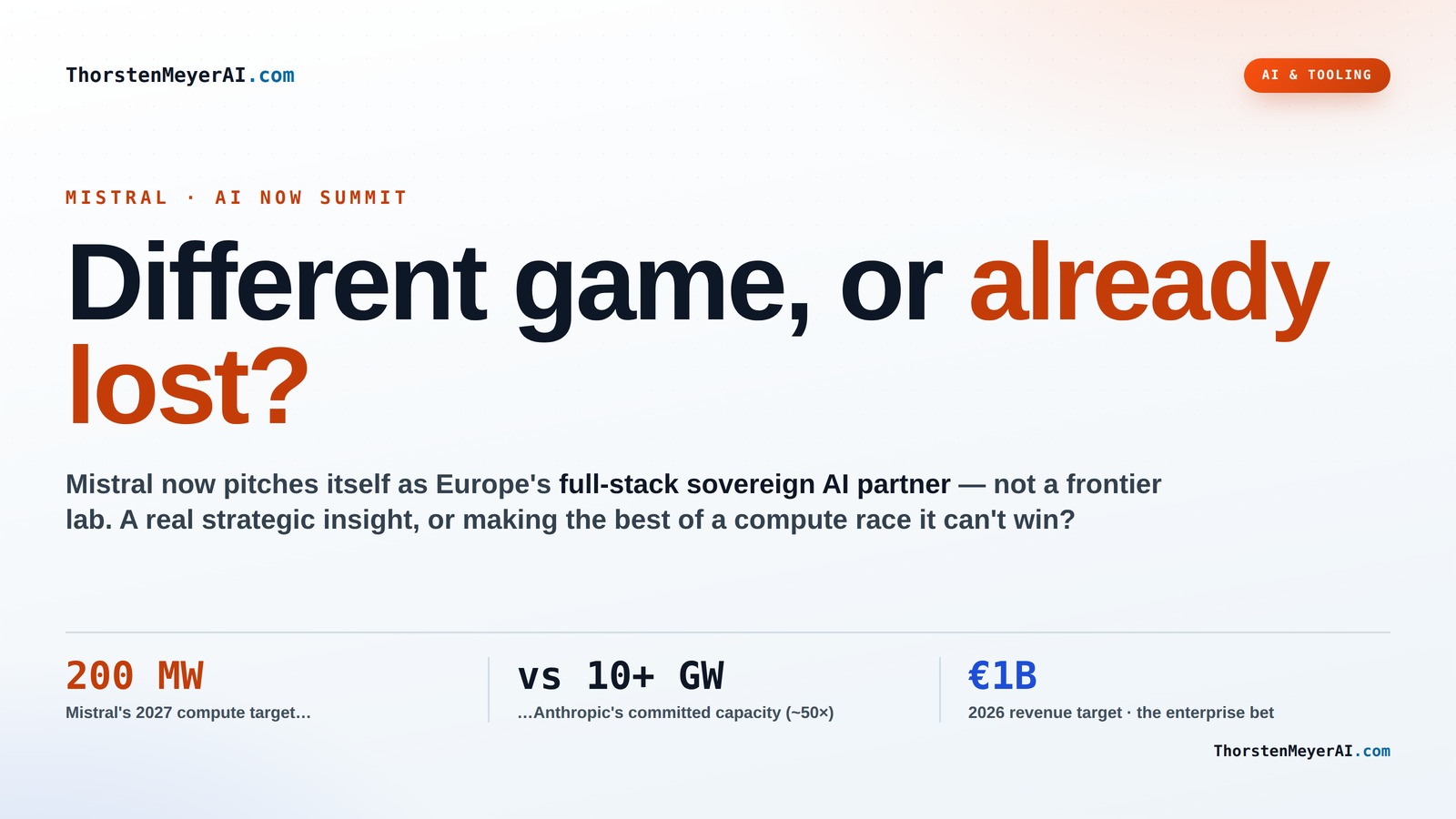
Different game, or already lost?
Mistral now pitches itself as Europe’s full-stack AI provider — compute, models, platform, consultancy — not a frontier-model lab. Is that a real strategic insight, or making the best of a race it can’t win? Both readings fit the same facts.
From model lab to full-stack provider
The clearest signal from the summit wasn’t a model — it was a posture. Heavy on enterprise logos and partnerships (ASML, BNP Paribas, Alexa+), light on new-model announcements. That absence is exactly what skeptics seized on.
Compute
40MW Paris DC + Sweden build · 200MW target by 2027
Models
Open & custom · efficient · you own and run them
Platform
Forge for custom models · Vibe for Work agent
Consultancy
Sales teams, integrators, EU provenance & support
Small & focused, or large & general?
Mistral bets on specialized small models. The claim isn’t that they win a reasoning leaderboard — they don’t. It’s that on the metrics that matter in production agent systems, a purpose-built small model wins. Flip the metric to see the case reverse.
Small specialized vs large general — by what you measure
In token-heavy agentic apps making hundreds of calls, speed/energy/cost compound. Toggle the metric.
Narrow models doing real work
Each is one model doing one thing efficiently — the tangible version of the strategy. Strong on their own terms; the open question is whether the bundle beats a free Chinese open-weight download.
On-prem KYC compliance
Mistral models run inside the bank’s walls for know-your-customer checks. Sensitive financial data never leaves. (BNP was Mistral’s first customer, 2023.)
Voxtral multilingual voice
A focused voice model powering Alexa+ across Europe — speed and efficiency over raw size.
Robostral industrial robotics
Plus a “physics AI” push (via the Emmi acquisition) into aerospace, automotive & semiconductor design and simulation.
Document AI / OCR at scale
Large-scale text extraction — the unglamorous, high-volume enterprise work small models excel at.
The strategy is downstream of the compute gap
Once you see the raw numbers, “why is Mistral behind?” answers itself — and the specialized-small-model strategy starts looking partly like a smart adaptation to a binding constraint, not a pure philosophical choice.
Compute & capital · Mistral vs a frontier leader, this same week
Not a knock — it’s the constraint that forces the efficiency-first, sovereignty-wedge strategy. Adapting intelligently to your position is what good strategy is.
“I want them to win, but I’m worried”
That ambivalence is the most accurate read of where Mistral sits. The enterprise pivot gets read two opposite ways — and both deserve airing.
On-prem, real sales teams, the Koyeb deployment acquisition, EU provenance — exactly what regulated enterprises want, and stickier than consumer mindshare. Targeting €1B revenue in 2026 with 1,000 staff, up from 15 people and one customer in 2023. US closed-API labs structurally can’t match the sovereignty axis.
“Software consultancy with a data center,” not a foundation-model moat. Enterprise B2B is where European startups go when they can’t win consumer or world-scale SaaS. Why pay Mistral on-prem when you could run Qwen free? One paying Le Chat Pro user said the quality gap with frontier labs is now hard to ignore.
Key Takeaways
- Mistral is betting on sovereignty and control, not just model size or reasoning prowess.
- Its open-weight, self-hosted approach appeals strongly to regulated European sectors and governments.
- Technical limitations in reasoning and context handling pose risks, but deployment flexibility offers a strategic edge.
- Demand for sovereign AI in Europe remains high, driven by regulatory needs and strategic independence.
- Mistral’s success depends on maintaining technical competitiveness while capitalizing on its unique market positioning.
Products Worth Considering

Amazon Kindle Paperwhite (12th Generation, 2024), 16 GB, 7-inch Display, Jade

LG UltraGear 27-Inch QHD OLED Gaming Monitor, 240Hz, 0.03ms, G-SYNC Compatible, FreeSync Premium Pro, HDMI 2.1

Bose SoundLink Flex Bluetooth Speaker (2nd Gen), Portable Waterproof Speaker, Black
As an affiliate, we earn on qualifying purchases.
What does ‘sovereign AI’ really mean for Mistral?
‘Sovereign AI’ is about more than just owning models. It’s about controlling data, infrastructure, and upgrade paths, especially in regulated sectors like banking or defense. Read more on sovereign AI strategies.
Take BNP Paribas—one of Mistral’s first clients—using on-prem models to keep sensitive financial info within their servers. For them, trusting a US cloud provider isn’t an option. They want control, auditability, and compliance. That’s the core of sovereignty.
But here’s the twist: sovereignty isn’t just a political buzzword. It’s a business strategy. It means organizations can reduce their dependence on foreign technology providers, which might be subject to geopolitical risks, and instead rely on local, controllable infrastructure. This choice often involves tradeoffs—such as potentially higher costs or slower innovation cycles—but for certain sectors, the benefits of control and compliance outweigh these costs. It also signals a shift towards a model where AI becomes an embedded part of critical infrastructure, with implications for security and trust. In this context, sovereignty isn’t just about policy; it’s about strategic resilience in a digital age.

How is Mistral different from OpenAI and Anthropic?
| Feature | Mistral | OpenAI/Anthropic |
|---|---|---|
| Model access | Open weights, self-hosting, full control | Closed API, no access to weights |
| Deployment | On-prem, cloud, hybrid | Primarily cloud API |
| Focus | Sovereignty, regulation, enterprise control | Performance, general AI capabilities |
| Market target | European regulated sectors, governments | Global, consumer, enterprise |
Why do enterprises and governments care about open weights?
Open weights mean you can run models on your own hardware, tweak them, and keep your data inside your organization. For regulated sectors—like finance or defense—that’s not a luxury; it’s a necessity. They want assurance that sensitive info stays under their control.
Imagine a European bank running a model on-site to evaluate loan applications. They can’t risk data leaks or regulatory breaches with cloud providers outside Europe. Open weights give them peace of mind—and flexibility.
This operational independence allows organizations to adapt models precisely to their needs, develop custom features, and ensure compliance with strict regulations. It also reduces reliance on external vendors, which can be a strategic advantage in avoiding vendor lock-in and ensuring long-term control. However, this approach requires significant technical expertise and infrastructure investment, which can be a barrier for some organizations. The tradeoff is clear: greater control and security versus increased complexity and cost. For organizations prioritizing sovereignty and compliance, open weights are a crucial enabler of trust and operational resilience.

Is Mistral just positioning, or can it compete technically?
Critics argue Mistral’s models lag behind in reasoning and multi-turn context handling—key skills for advanced AI. They point out that smaller, specialized models may be more efficient but often don’t reach the same reasoning depth as giants like GPT-4. Insights on AI model development.
For example, Mistral’s small models excel at niche tasks—OCR, voice, industrial controls—but struggle with complex reasoning benchmarks. This raises a question: can they catch up, or is their niche too narrow?
It’s a classic tradeoff. Smaller models are faster, cheaper, and easier to deploy locally. But in a race for AI supremacy, model quality still matters. Mistral’s strategy hinges on their ability to excel in deployment and control, not just raw reasoning power. If they can improve their models’ reasoning capabilities over time, they could bridge the gap. However, the challenge lies in balancing rapid iteration and innovation with maintaining the core advantages of their approach—local control, customization, and sovereignty—without sacrificing performance. The implications are significant: if they fall behind in reasoning, their core value proposition for regulated and enterprise clients could weaken, forcing them to reconsider their technical roadmap or risk losing relevance in a highly competitive landscape.

What’s really driving demand for sovereign AI in Europe?
Europe’s push for sovereignty isn’t just political talk. Countries and large companies are genuinely concerned about digital independence, especially after recent data scandals and regulatory crackdowns. Discover the latest trends in European tech and AI.
Recent reports show that more than 80% of EU digital infrastructure relies on non-EU providers. That’s a strategic vulnerability. Explore AI safety and control best practices.
Think of a government agency wanting to run AI on secure, European-owned servers for national security reasons. That’s not just about privacy—it’s about sovereignty as a strategic asset. This demand is driven by a combination of regulatory pressure, geopolitical considerations, and a desire for technological independence. The implications are profound: reliance on foreign AI providers could expose European institutions to security risks, data sovereignty issues, and loss of control over critical infrastructure. As a result, the market for sovereign AI is not just a niche—it's becoming a strategic priority.

Can Mistral’s strategy survive technical catch-up?
Here’s the big worry: critics say Mistral’s models are falling behind in reasoning and multi-turn understanding. If they can’t keep pace, their core market—regulated enterprises needing high reliability—might shrink.
For instance, if a European bank needs a model that understands complex legal language or financial regulations, and Mistral’s models can’t keep up with the reasoning of US-based models, their value diminishes.
But Mistral argues that their focus on deployment, customization, and control still gives them a competitive edge. It’s a different kind of race—one where sovereignty and compliance matter more than raw model size. They are betting that their emphasis on local deployment and compliance will offset some technical gaps, especially in markets where security and control are paramount. However, if technical capabilities don’t improve at a comparable pace, they risk losing their competitive edge to better-performing models from their rivals. The tradeoff here is between continuous technical innovation and the strategic advantages of sovereignty—both are critical, but balancing them is complex. The implications are that if Mistral cannot keep up in reasoning and multi-turn understanding, their core value proposition could erode, forcing a reassessment of their long-term viability in the AI ecosystem.
Who exactly is buying into Mistral’s vision?
Mistral’s ideal customers are organizations that must keep data within their own borders—like European banks, public agencies, and defense contractors. They don’t just want a powerful model—they want control, compliance, and customization.
For example, a government agency in France uses Mistral models to analyze legal documents without risking data leaks. They value the ability to fine-tune models and run them locally.
This isn’t about replacing Google or Bing—it's about a niche that values sovereignty over sheer performance. These organizations see control and security as critical, especially when dealing with sensitive or classified information. They are willing to accept potential tradeoffs in model performance or speed in exchange for peace of mind that their data remains under their control and that their AI systems are compliant with strict regulations. This focus on sovereignty-driven clients shapes Mistral’s product development and marketing strategies, emphasizing trust, security, and customization as key differentiators in a crowded AI landscape.

What does success look like for Mistral?
Success isn’t about beating GPT-4 on accuracy—it’s about becoming the go-to provider for European organizations needing sovereignty, control, and compliance. If they can secure a sizable share of regulated markets, they’ve achieved their goal.
Imagine a future where European banks, hospitals, and government agencies rely on Mistral models to keep their data local, audit their AI, and customize their tools. That’s a win.
The real challenge is whether Mistral can maintain or improve their model quality as they scale their ecosystem. Their success depends on striking a delicate balance: offering enough technical performance to meet enterprise needs while cultivating a trusted, sovereignty-focused ecosystem that appeals to their niche markets. If they can do this effectively, they could reshape the European AI landscape, establishing a new standard for sovereignty and control. Conversely, if technical shortcomings persist, their market share could be limited, and their long-term viability might be at risk, especially as global competitors continue to advance their models.
Conclusion
Mistral isn’t just competing in the same race as OpenAI or Anthropic. It’s playing a different game—focused on sovereignty, control, and enterprise trust.
If they can keep their technical edge while nurturing this niche, they could redefine what AI independence means for Europe. But the clock is ticking. Will sovereignty truly be enough to stay ahead, or is it a shield that shields them from the real race?