
📊 Full opportunity report: Forge or Self-Host? The Real Cost of Sovereign AI on ThorstenMeyerAI.com — validation score, market gap, and execution plan.

Get the latest gadgets delivered free with Prime
- Fast, free delivery on millions of items
- Prime Video, Amazon Music and more included
- Member-only deals all year
TL;DR
Recent market shifts have closed the capability gap between open-weight and proprietary models, while the cost of self-hosting remains higher than assumed. This challenges the traditional advice for organizations seeking control over AI data and models.
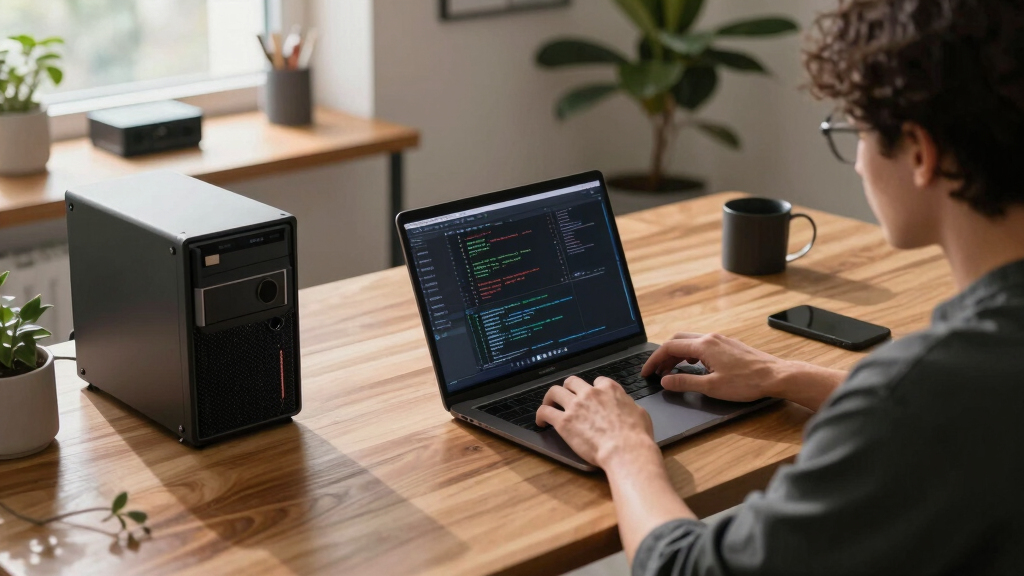
Recent analysis shows that the long-held belief that self-hosting sovereign AI is cheaper than buying managed solutions no longer holds true for most organizations. The Real Cost of a Local-Inference Rig in 2026 The capability gap between open-weight and frontier models has nearly closed, but the cost gap remains significant, often making self-hosting more expensive overall.
According to recent industry assessments, the primary costs associated with self-hosting AI models include GPU hardware, idle hardware penalties, and human operational expenses. A typical GPU setup for serious deployment ranges from $2,000 to $20,000 per month, depending on the model size and rental terms, with on-demand hyperscaler prices rising due to supply constraints. Microsoft reports are exposing AI’s real cost problem Idle hardware costs remain a hidden but substantial expense, as dedicated GPUs bill for full capacity regardless of utilization, which often hovers around 5–10% in practice.
Furthermore, the human costs—such as DevOps or MLOps engineers—add significantly to the total expense, often making self-hosting 2–5 times more costly per token than managed API services. This financial picture contradicts the traditional narrative that self-hosting is a cost-saving measure, especially at lower utilization levels. Meanwhile, recent open models like Z.ai’s GLM-5.2 demonstrate that open-weight models now rival proprietary models in many tasks, further diminishing the cost argument based solely on capability gaps.
Forge or Self-Host?
The Real Cost of Sovereign AI
Sovereignty is the reason. Cost usually isn’t. — Forge Trilogy, Part 3
Two ways to buy control
Managed sovereignty (Forge-style)
- Full lifecycle: pre-training, post-training, RL on your data, in your jurisdiction
- Vendor’s training recipes + orchestration — no ML-infra team required
- Platform dependency: Mistral architectures only, for now
- Open question: do most enterprises need custom-trained models at all?
DIY self-hosting (open weights)
- Maximum control: air-gap capable, no vendor can switch you off
- GPU floor $2–20k/mo; H100 rates rose ~14% y/y
- Idle penalty ~10× below ~30% utilization — the silent budget killer
- The human: DevOps/MLOps runs €62–89k gross in Germany, seniors €100k+
The capability excuse evaporated — GLM-5.2 (open, MIT) vs Claude Opus 4.8
The answer that works: route, don’t choose (Bifröst pattern)
The verdict: self-hosting usually isn’t cheaper — but the capability tax on sovereignty has collapsed to a few points. You no longer sacrifice quality for control; you only pay for it. Price it honestly, then decide whether you’re buying insurance or ideology.
Impact on Organizations Choosing Sovereign AI Strategies
This analysis underscores that many organizations may find self-hosting economically unviable compared to managed solutions, especially given the high hardware and human costs. The improved performance of open models narrows the capability gap, reducing the justification for expensive, complex self-hosted setups. As a result, decision-makers need to reconsider sovereignty strategies, balancing control with cost-efficiency, and not relying solely on the assumption that self-hosting is cheaper.
As an affiliate, we earn on qualifying purchases.
Evolution of Sovereign AI Economics and Capabilities in 2026
For two years, the dominant advice for achieving sovereignty was to self-host models, accepting a performance trade-off. However, recent developments—such as the release of large, permissively licensed open models like GLM-5.2—have challenged this premise. Meanwhile, hardware costs have not decreased as expected; GPU prices have risen, and utilization inefficiencies persist, making self-hosting more expensive than previously thought. The industry is also witnessing a shift in the capability landscape, with open models now approaching proprietary performance levels for many enterprise tasks.
“GPU prices are rising due to supply constraints, making self-hosting increasingly expensive, contrary to many assumptions.”
— Industry source familiar with GPU pricing
As an affiliate, we earn on qualifying purchases.
Remaining Questions About Future Cost Dynamics and Model Performance
It remains unclear how GPU supply will evolve and whether hardware costs will stabilize or continue rising. Additionally, the long-term performance trajectory of open models compared to proprietary ones is still uncertain, especially for complex, autonomous tasks. The economic impact of potential breakthroughs in hardware efficiency or licensing models also remains to be seen.
As an affiliate, we earn on qualifying purchases.
Next Steps for Organizations Evaluating Sovereign AI Options
Organizations should conduct detailed cost-benefit analyses considering current hardware prices, utilization rates, and model capabilities. Industry watchers expect further performance improvements in open models and potential hardware cost stabilization, which could influence future sovereignty strategies. Decision-makers will need to reassess whether self-hosting remains a viable option or if managed solutions provide better value in the evolving landscape.
As an affiliate, we earn on qualifying purchases.
Key Questions
Is self-hosting still a cost-effective way to achieve sovereignty?
For most organizations, recent data suggests that self-hosting is now more expensive than managed API solutions, especially at typical utilization levels, due to hardware and human costs.
How have open models like GLM-5.2 affected the sovereignty debate?
Open models now rival proprietary models in many tasks, reducing the capability gap and challenging the notion that self-hosting is necessary for high performance.
What are the main hidden costs of self-hosting AI models?
Idle hardware costs, human operational expenses, and the inefficiency of low utilization rates significantly increase the total cost of self-hosting.
Will hardware prices stabilize or continue rising?
It is uncertain; current trends show rising GPU prices due to supply constraints, but future developments could alter this trajectory.
Should organizations abandon sovereignty for cost reasons?
Not necessarily; some may prioritize control over cost, but current economic realities suggest many will find managed solutions more practical.
Source: ThorstenMeyerAI.com
Halloween Picks
halloween
As an affiliate, we earn on qualifying purchases.