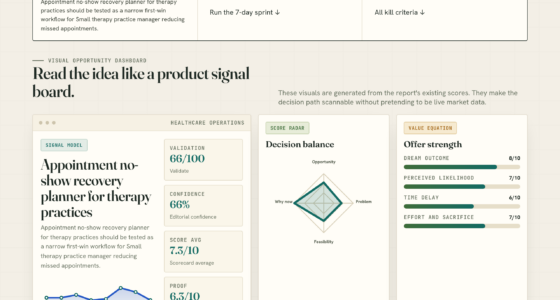
📊 Full opportunity report: From Anxious To Prepared: IEP Negotiation Simulators For Parents on IdeaNavigator AI — validation score, market gap, and execution plan.

Get the latest gadgets delivered free — and shop member deals
- Fast, free delivery on millions of items
- Access to Prime Big Deal Days deals on October 6–7
- Prime Video, Amazon Music and more included
TL;DR
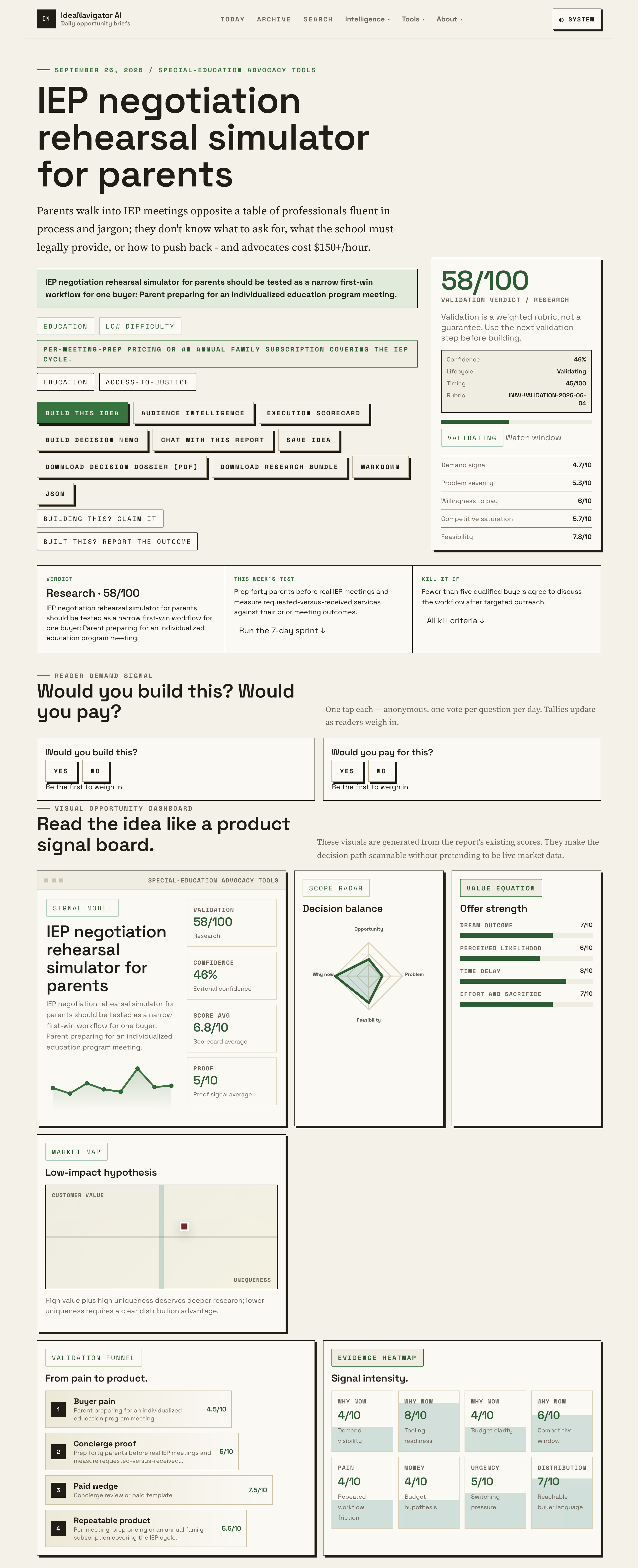
IdeaNavigator AI has published a product concept for an AI-powered IEP meeting rehearsal simulator that would let parents upload their child’s education plan, learn their legal entitlements, and practice negotiations with realistic pushback. The idea responds to rising special-education identification rates, tightening district resources, and advocate fees of $150 or more per hour. It remains unvalidated until tested with real parents ahead of actual meetings.
A new product concept from IdeaNavigator AI recommends building and testing an IEP negotiation rehearsal simulator — an AI tool that role-plays individualized education program meetings with parents so they can practice pushing back against school staff before walking into the real thing. The proposal targets a single buyer: a parent preparing for an IEP meeting, and argues that large language model role-play is now realistic enough to simulate the high-stakes, jargon-heavy encounters that many parents find intimidating.
The concept identifies a specific problem: parents typically enter IEP meetings seated opposite a table of education professionals who are fluent in the process, the paperwork, and the terminology. According to the proposal, parents often do not know what to ask for, what the school is legally required to provide, or how to push back when requests are declined. Professional advocates who can bridge that gap charge $150 or more per hour, putting sustained expert help out of reach for many families.
The proposed minimum viable product works in three stages. First, a parent uploads their child’s current IEP and evaluation reports. The tool then explains the family’s entitlements in plain language and generates a request list with legal grounding for each item. Finally, it role-plays the meeting itself — including realistic opposition from the simulated school team — repeating until the parent can hold their positions under pressure.
Two monetization models are suggested: per-meeting-prep pricing for one-off preparation, or an annual family subscription covering the full IEP cycle, which typically includes annual reviews, evaluations, and re-evaluations. The concept places the product in the special-education advocacy tools market.
Why Parents May Need Rehearsal Tools
The concept’s timing argument rests on two converging pressures. Special-education identification rates keep climbing, while district resources tighten — a combination the proposal says is making IEP meetings more adversarial. When more students need services and budgets do not keep pace, schools have stronger incentives to limit what they offer, and parents without negotiation preparation are the least equipped to respond.
If validated, the tool could shift some of the informational advantage that school teams hold. A parent who has rehearsed responses to common pushback — and who arrives with a legally grounded request list — may secure services closer to what their child is entitled to receive. The proposed validation method makes this measurable: prep forty parents before real IEP meetings and compare requested-versus-received services against each family’s prior meeting outcomes.
The stakes extend beyond any single meeting. Services written into an IEP — therapy hours, accommodations, aides, placement — shape a child’s daily school experience for a full year or more, and gaps are often only correctable at the next annual review.
Top picks for "anxiou prepar negotiation"
As an affiliate, we earn on qualifying purchases.
How LLM Role-Play Made This Possible
The proposal’s stated ‘why now’ is technological: LLM role-play is now good enough to simulate a realistic IEP meeting, including the tone and tactics of a school team responding to parent requests. Earlier chatbots struggled to sustain a convincing adversarial role over a long, document-grounded conversation; current models can hold a persona, reference uploaded evaluation reports, and respond to nuanced negotiation moves.
The concept also fits a broader pattern of AI tools moving into consumer preparation for high-stakes encounters — interview practice, salary negotiation, and difficult conversations. IEP meetings combine several features that make them well suited to this approach: they are scripted by regulation, they revolve around documents a tool can parse, and the counterparty’s likely arguments are predictable enough to rehearse against.
What Is Unproven About the Concept
This is a product concept, not a shipped or validated product. No build, pilot, or outcome data exists yet; the forty-parent validation study is proposed, not completed. Whether simulated pushback accurately reflects real school-team behavior is untested, and it is not clear how the tool would handle the wide variation in state special-education law and district practice.
Legal accuracy is an open risk. An AI-generated ‘request list with legal grounding’ that misstates entitlements could leave parents worse prepared, not better. The concept does not specify how legal content would be reviewed, whether a special-education attorney or advocate would be involved, or what disclaimers would apply. Data privacy is also unaddressed: uploading an IEP and evaluation reports means entrusting a tool with sensitive information about a child’s disabilities, and no handling or retention approach is described.
The Path From Concept to Evidence
Under the concept’s own validation plan, the next step is recruiting forty parents with real IEP meetings approaching, running them through the preparation workflow, and tracking requested-versus-received services against their prior outcomes. A developer or team would need to build the MVP — document upload, plain-language entitlement explanations, legally grounded request generation, and the role-play engine — before that study can begin.
If the validation shows improved outcomes, the concept anticipates scaling through per-meeting or subscription pricing. If it does not, the idea would need revision or abandonment. For now, parents facing IEP meetings still rely on existing options: free parent training centers, published special-education rights guides, and paid advocates at $150 or more per hour.
Source: IdeaNavigator AI
Key Questions
Does an IEP meeting simulator exist today?
Not as a validated product. What exists is a published product concept from IdeaNavigator AI recommending that such a tool be built and tested. The forty-parent validation study has not been run.
How would the simulator prepare a parent?
According to the concept, a parent uploads the current IEP and evaluation reports, receives plain-language explanations of entitlements and a legally grounded request list, then role-plays the meeting with realistic pushback until they can hold their positions.
Why don’t parents just hire an advocate?
Many do, but the concept notes advocates charge $150 or more per hour, which limits access for many families. A subscription or per-meeting AI tool could cost far less, though its effectiveness is unproven.
What are the main risks of the idea?
The tool could misstate legal entitlements, may not reflect how real school teams negotiate, and would hold sensitive child disability records — with no data-handling approach described in the concept.
How would anyone know if it actually works?
The proposed test is to prep forty parents before real IEP meetings and compare requested-versus-received services against each family’s prior meeting outcomes. Until that study is done, any benefit is speculative.
Source: IdeaNavigator AI
Fall Picks
fall essentials
As an affiliate, we earn on qualifying purchases.