
TL;DR
Glasspane is being presented as an open-source, self-hostable platform for real-time infrastructure transparency, with role-based views and an AI layer that explains status, risk, and next steps. The source material describes three newer capabilities: workforce growth tracking, AI model telemetry, and time-limited public sharing.
Glasspane is being positioned as a self-hostable infrastructure transparency platform for managed service providers and enterprise IT teams, with three newer capabilities that extend its reporting beyond system health into workforce evidence, AI model telemetry, and time-limited public sharing.
The source material from Thorsten Meyer AI describes Glasspane as an AGPL-3.0 open-source product built around real-time, role-aware infrastructure visibility. It says the platform supports eight AI providers, three role views, and self-hosting, allowing teams to present the same underlying infrastructure data differently to executives, account managers, and on-call engineers.
The three newer capabilities are described as workforce growth, AI model transparency, and public transparency sharing. Workforce growth is said to connect career-ladder progression, skills, goals, and AI-generated recommendations to evidence from the next role level. AI model transparency is described as telemetry across AI calls, including latency, errors, fallback events, version drift, provider, model, version, and response time. Public sharing is described as time-limited, role-based links that expose selected public-safe widgets in a read-only view.
The company’s framing is that Glasspane is not only another monitoring dashboard. According to the source material, the product’s central claim is that infrastructure data, AI provenance, public access, and staff development form one transparency system rather than separate features.
When transparency itself becomes the product
The infrastructure is healthy — but nobody can see it. Static PDFs and “trust us” status calls don’t scale. Glasspane replaces them with real-time, role-aware transparency, and an AI layer that explains what’s happening, why it matters, and what to do next.
“It’s healthy — trust us” doesn’t scale
MSPs and enterprise IT share the same problem from opposite sides of the table: the same question, asked over and over in different words — how do I know?
- Monthly PDF reports, already out of date
- Screenshots pasted into slide decks
- “Trust us, it’s fine” status calls
- Real-time status, not last month’s
- The right view for each audience
- AI that says what to do next

The Prometheus and Grafana Guide: Real Time Infrastructure Monitoring for DevOps Engineers
As an affiliate, we earn on qualifying purchases.
As an affiliate, we earn on qualifying purchases.
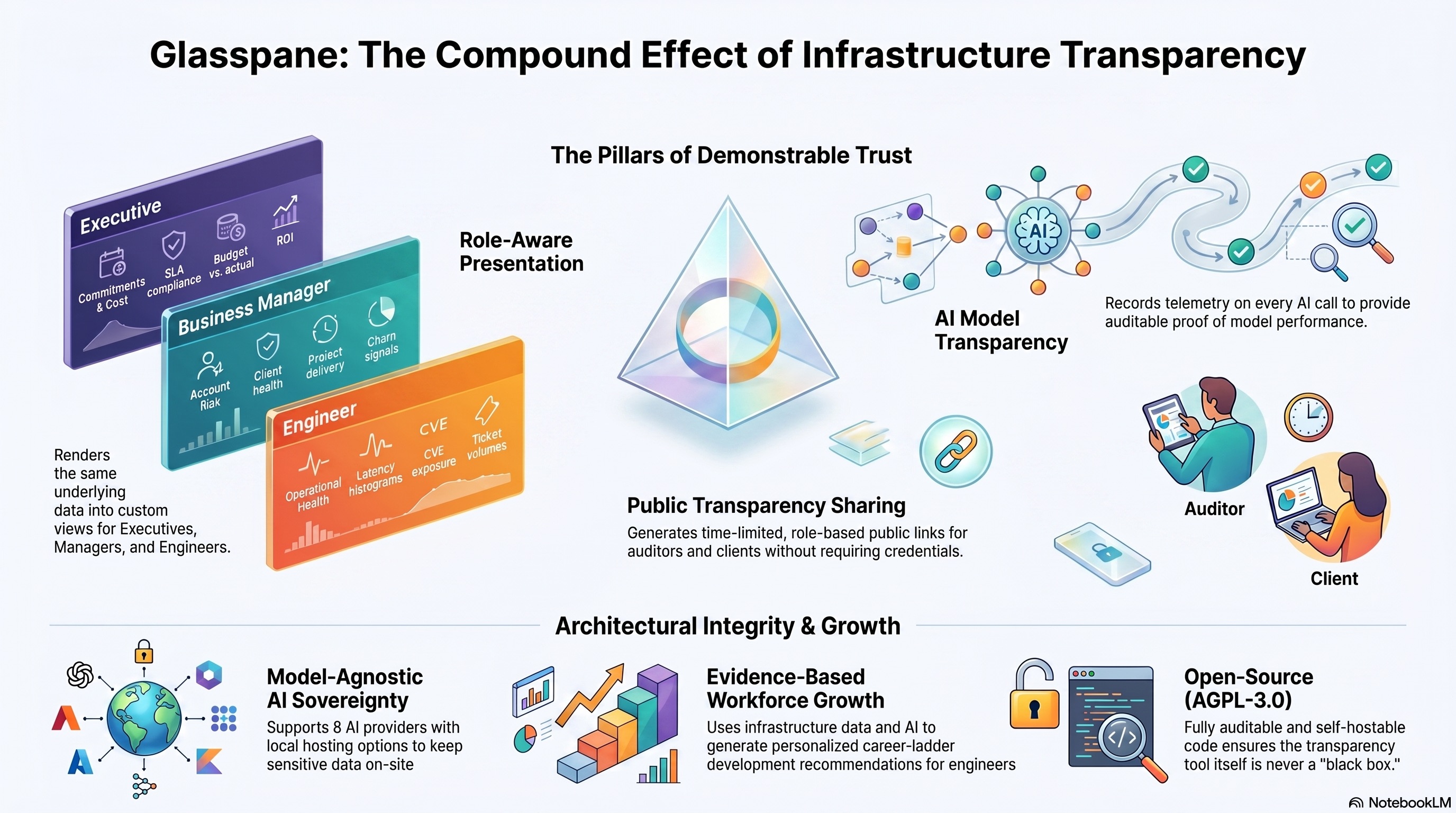
One dataset, three audiences
The CFO, the account manager, and the on-call engineer look at the same infrastructure — but need completely different things from it. A dashboard that forces a CFO to read latency histograms is a dashboard the CFO closes. Switch the role and watch the same data re-present itself.
Role-aware presentation
The data underneath is identical. Only the framing changes — fitted to whoever’s asking.

LittleMum Trigger Point Massager Dolly, Myofascial Release Occipital Neuralgia, Neck & Shoulder Pain, Tension Headache, TMJ
Relieve occipital neuralgia, neck and shoulder pain, and tension headaches, TMJ by using the LittleMum Massager Dolly to…
As an affiliate, we earn on qualifying purchases.
As an affiliate, we earn on qualifying purchases.
Model-agnostic — and inspectable by design
The AI turns what is happening into why it matters and what to do next. Two architectural choices keep that layer from becoming a liability.
Eight providers · assign per task · automatic fallback
If a primary provider fails, the next takes over transparently. Run a local model and sensitive infrastructure data never leaves your network.
Per-task + fallback chains
A different provider per task with one env var each; define a chain so a failure fails over, not down.
AGPL-3.0 · self-hostable
A transparency tool that can’t be audited would be a contradiction. Every line is inspectable.
![Norton 360 Deluxe, Antivirus software for 5 Devices with Auto-Renewal – Includes Advanced AI Scam Protection, VPN, Dark Web Monitoring & PC Cloud Backup [Download]](https://m.media-amazon.com/images/I/51Ovcl9mAAL._SL500_.jpg)
Norton 360 Deluxe, Antivirus software for 5 Devices with Auto-Renewal – Includes Advanced AI Scam Protection, VPN, Dark Web Monitoring & PC Cloud Backup [Download]
ONGOING PROTECTION Download instantly & install protection for 5 PCs, Macs, iOS or Android devices in minutes!
As an affiliate, we earn on qualifying purchases.
As an affiliate, we earn on qualifying purchases.
Each feature extends the same thesis
None is really standalone. Each pushes transparency onto a new surface — the people, the AI itself, and the outsiders who need to see in.
Transparency for the people who run it
Career-ladder progression, growth signals, skills & goals — with AI generating evidence-backed development recommendations grounded in the next rung. Turns reviews from anecdote into evidence.
The tool that watches itself
Telemetry on every AI call — latency, errors, fallback events, version drift — across 1h / 24h / 7d. Alerts on degradation or version drift; every result footnotes the exact provider, model, version & latency.
Trust, delivered safely
Time-limited, role-based public links. Choose an audience, curate widgets from a public-safe whitelist, set an expiry. A read-only “Transparency Center” — no login, nothing you didn’t share.
self-hosted infrastructure visibility platform
As an affiliate, we earn on qualifying purchases.
As an affiliate, we earn on qualifying purchases.
Transparency compounds
Each layer is only as valuable as the one beneath it is credible — which is exactly why one coherent system beats bolting any single piece onto a tool that hasn’t earned the layers below.
The compounding stack
Infrastructure data
earns a customer’s trust — SLAs, security, cost, operations
Model Transparency
earns trust in the AI interpreting that data — no unaccountable black box
Public Sharing
delivers that trust directly & safely to the people who need it
Workforce Growth
extends the same evidence-based philosophy to the team behind it
Why It Matters
The product matters for MSPs and internal IT teams because infrastructure reporting often has to satisfy different audiences at once: executives want service and cost signals, engineers need operational detail, account teams need client-ready status, and auditors may need evidence without access to internal systems.
If the features work as described, Glasspane could reduce reliance on manual monthly reports, screenshots, and status calls by giving stakeholders a live but controlled view of infrastructure condition and related evidence. The AI telemetry feature also addresses a growing governance issue: whether teams can trace which model produced a recommendation, how long it took, whether a fallback was used, and whether a provider changed behavior over time.
Background
The source material frames Glasspane around a shared problem for MSPs and enterprise IT: systems may be healthy, but the proof is often fragmented or stale. Traditional reporting methods can leave customers, executives, and auditors asking how they can verify the state of infrastructure without depending only on assurances from IT staff.
Glasspane’s role-based design is meant to answer that by re-presenting the same dataset for different audiences. The material gives the example of an executive view focused on commitments and cost rather than latency histograms. Its AI layer is described as model-agnostic, with provider assignment by task, fallback chains, and support for local models through Ollama and LM Studio.
What Remains Unclear
The source material does not specify a release date, pricing, customer count, deployment requirements, independent benchmarks, or whether the three newer capabilities are generally available, in beta, or planned. It is also not clear how Glasspane validates AI-generated recommendations, how public-safe widget rules are enforced, or what third-party audits have reviewed the platform.
What’s Next
The next items to watch are availability details for the three newer features, technical documentation for role-based sharing and AI telemetry, and evidence from customer deployments showing how the platform performs in MSP and enterprise environments.
Key Questions
What is Glasspane?
Glasspane is described as an open-source, self-hostable infrastructure transparency platform for MSPs and enterprise IT teams. It presents real-time infrastructure data in role-specific views and adds an AI layer that explains status and recommended next steps.
What are the new capabilities described in the source material?
The source material lists workforce growth, AI model transparency, and public transparency sharing. These cover staff development evidence, telemetry on AI calls, and controlled read-only sharing through time-limited public links.
Which AI providers does Glasspane support?
The source material says Glasspane supports OpenAI, Anthropic, Google Gemini, IBM watsonx, OpenRouter, AWS Bedrock, Ollama, and LM Studio, with provider assignment by task and fallback chains.
What remains unconfirmed?
The provided material does not give launch timing, pricing, customer adoption, independent validation, or detailed security controls for public sharing. Those details would need confirmation from product documentation or company statements.
Source: Thorsten Meyer AI