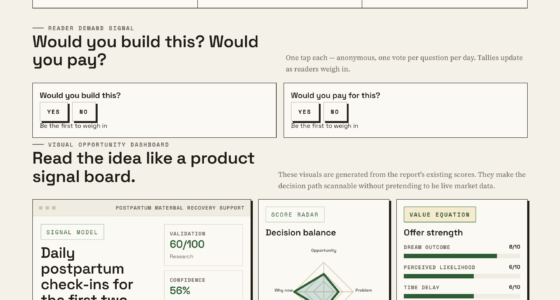
📊 Full opportunity report: How To Use A Voice Journal To Reflect On Motherhood on IdeaNavigator AI — validation score, market gap, and execution plan.

Get the latest gadgets delivered free with Prime
- Fast, free delivery on millions of items
- Prime Video, Amazon Music and more included
- Member-only deals all year
TL;DR

IdeaNavigator AI has proposed a voice journal designed to record mothers’ own experiences, not only a child’s feeds and milestones. Its suggested app features and business model are a product concept, not evidence of a launched service or proven demand; the proposal recommends testing the idea with 200 new mothers.
IdeaNavigator AI has proposed a voice-journaling app for mothers that would capture their reflections through short audio entries, then organize them into themes and revisit them over time. The concept addresses a gap the proposal identifies in baby-focused apps: parents may record feeds and milestones while a mother’s own experiences go unrecorded, but no launch, user research results or evidence of demand is provided.
The proposed first users are mothers who have little time or free hands but want to remember more than a child’s developmental milestones. The idea is to let someone record a thought during an everyday moment, such as a feeding or a walk, instead of needing to type. The proposal points to speech-to-text quality and growing attention to maternal mental health as reasons to explore a mother-centered product; it does not cite specific studies or market data to substantiate those claims.
The proposed minimum product would include one-tap voice capture and transcription, tagging of emotional themes, and weekly reflections that surface patterns in entries. It could also bring back recordings around anniversaries and turn entries into private yearly books. The concept suggests a subscription and paid printed-book add-ons, but gives no pricing, privacy specifications, production costs or details about how recordings would be stored.
For validation, IdeaNavigator AI proposes a pilot with 200 new mothers. It recommends tracking entries per week through the third month and testing whether participants convert to printed books around a child’s first birthday. These are suggested measures, not reported trial results. No recruitment plan, comparison group, participant safeguards or threshold for deciding whether the idea succeeds is described.
A Record of the Mother’s Experience
The proposal shifts the focus of a familiar parenting tool: rather than mainly logging a child’s care and development, it would preserve the mother’s own account of early parenthood. That could offer a practical way to record changing feelings, relationships and identity during a period when typing may be difficult. The potential value is personal and organizational; the proposal does not establish that journaling improves mental health or relationships.
The idea also raises practical questions for anyone considering such a service. Audio entries may include sensitive reflections about health, family members or a child. A product that asks users to entrust it with those recordings would need clear choices about privacy, retention and deletion, as well as accessible ways to review or export entries. Those details are not included in the concept.
The proposed pilot could help distinguish initial curiosity from sustained use. A high number of early recordings alone would not show whether users find the service useful over time, while book purchases would measure one commercial outcome rather than the full value users might place on the journal. The suggested measures offer a starting point, but the proposal does not define how results would be interpreted.
As an affiliate, we earn on qualifying purchases.
From Baby Logs to Personal Journals
Many parenting apps are organized around practical child-related records, including feeding schedules and developmental milestones. IdeaNavigator AI frames its concept as a response to that emphasis: a mother’s perspective can be harder to capture when she has little uninterrupted time. The proposed voice-first format is intended to reduce the effort required to make an entry, while transcription and later reflections would make recordings easier to revisit.
The concept is at the idea and validation stage in the information provided. It outlines a target user, a feature set, a possible revenue model and a proposed pilot, but does not identify a product team, launch schedule or existing app. Nor does it provide independent evidence that speech recognition works reliably in the settings described, or that mothers want automated emotional-theme labels and anniversary reminders.
motherhood keepsake journal with prompts
As an affiliate, we earn on qualifying purchases.
As an affiliate, we earn on qualifying purchases.
Demand, Privacy and Results
Whether mothers will use the product regularly remains unknown. No interviews, survey findings, pilot data or retention figures accompany the proposal. It also does not establish whether users would welcome automated emotional tagging, weekly pattern summaries or reminders tied to a child’s age.
Other open questions include how the app would handle inaccurate transcription, sensitive audio, data security and sharing or deletion. The proposal does not say whether the yearly books would be produced automatically or reviewed by the user, how much they would cost, or what privacy protections would apply. The suggested 200-person test has no stated timetable, recruitment method or published outcome.
portable digital voice recorder for journaling
As an affiliate, we earn on qualifying purchases.
As an affiliate, we earn on qualifying purchases.
Testing Repeat Use and Book Sales
The next step described in the proposal is a pilot involving 200 new mothers, with weekly entries tracked through month three and printed-book interest tested around the first birthday. No start date or confirmation that the test has been organized is provided. Any future announcement would need to clarify the app’s privacy safeguards, pricing and how the team will judge continued use.
Until results are available, the concept should be treated as an unvalidated product proposal rather than a service with demonstrated benefits. Evidence about repeated use, user feedback and book purchases would help show whether the proposed format meets a need and can support its suggested subscription model.
Source: IdeaNavigator AI
As an affiliate, we earn on qualifying purchases.
Key Questions
Is this voice-journaling app available now?
The information provided describes a product concept, not an app confirmed to be available. No launch date or product name is given.
What would the proposed journal do?
It would let users make voice entries, transcribe them, tag emotional themes and receive weekly reflections. The concept also suggests anniversary reminders and private yearly books.
Has a pilot with 200 mothers been completed?
No results are reported. IdeaNavigator AI proposes a pilot with 200 new mothers and suggests measuring weekly entries through month three, followed by printed-book conversion around the first birthday.
Would the journal improve maternal mental health?
The proposal does not provide evidence that journaling through the app would improve mental health. It presents the product as a way to record mothers’ experiences, not as a tested treatment or clinical service.
Source: IdeaNavigator AI
Halloween Picks
halloween
As an affiliate, we earn on qualifying purchases.