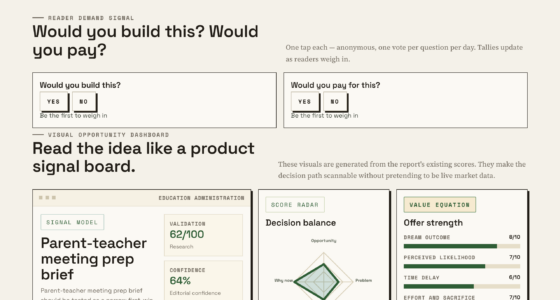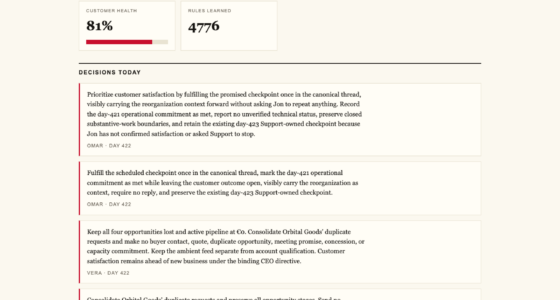
📊 Full opportunity report: Introducing Forezai · TradingAgents — a committee of LLMs decides paper-trades on ThorstenMeyerAI.com — validation score, market gap, and execution plan.
TL;DR
Forezai · TradingAgents is a new framework where multiple LLMs collaborate to simulate trading decisions. It adds operational features to a research prototype, enabling automated paper trading and analysis. Its development highlights AI’s potential and current limitations in market decision-making.
Forezai · TradingAgents, a new software fork, now enables a committee of large language models (LLMs) to autonomously execute paper trades using a structured multi-agent framework. This development transforms a research prototype into an operational tool, facilitating systematic testing of LLM decision-making in simulated trading environments. The project aims to explore whether AI models, when structured into specialized roles and arguments, can produce trading decisions at least as effective as random choices, without promising predictive accuracy.
The core of Forezai · TradingAgents is a fork of an existing multi-agent architecture designed by TauricResearch, which organizes LLMs into roles such as analysts, debate agents, risk teams, and decision-makers. The framework does not claim that the LLMs predict markets but instead emphasizes explicit reasoning through competing voices, with the final output being a trading recommendation.
The new features added by Forezai include an autonomous loop that runs daily, a scheduler that executes the agent graph, and an auto-trader that maps ratings into simulated orders. It supports multiple modes, including local simulation, Alpaca paper trading, and a shadow mode for divergence analysis. Additionally, the system features a web dashboard built with FastAPI and React, providing real-time performance metrics, equity curves, and detailed logs, all running locally without cloud data transfer.
Importantly, the system is designed for research, not real trading; it explicitly refuses to execute live trades unless operators override safety measures. The framework also supports multi-broker abstraction and detailed audit logs, making it suitable for systematic testing and analysis of LLM decision-making processes in trading scenarios.
Introducing Forezai · TradingAgents.
A committee of LLMs
decides paper-trades.
Analysts · Debate · Risk · Decision
combined with -33% bankroll
services, HTTP routes (starting baseline)
(falls back to public API per token)
The bet is on a different mechanism, not a different parameter setting. The point is not to find a money-printing AI. The point is to put honest measurements of these systems into the public record — so the next person looking at the space starts a step further along than the last.Thorsten Meyer AI · Introducing Forezai · TradingAgents · § 03
Implications for AI-Driven Market Decision-Making
Forezai · TradingAgents represents a significant step in operationalizing multi-agent LLM frameworks for financial research, demonstrating how structured AI collaboration can be used to simulate trading strategies. While it does not aim to predict markets, it tests whether AI models can make consistent, reasoned decisions comparable to random chance, providing insights into the capabilities and limitations of current AI in complex decision environments. This development can influence future research on AI explainability, multi-agent reasoning, and automated trading systems, especially in understanding how AI reasoning can be made explicit and auditable.

Mastering the Art of Equity Trading Through Simulation, + Web-Based Software: The TraderEx Course (Wiley Trading)
As an affiliate, we earn on qualifying purchases.
As an affiliate, we earn on qualifying purchases.
Evolution of AI in Algorithmic Trading Research
Previous experiments, such as those involving the Polybot system on Polymarket prediction markets, revealed that many parametric trading strategies fail to survive real-world testing, often producing false edges in backtests. These findings underscored the challenge of developing reliable, rule-based trading algorithms. The shift towards using LLMs in structured, multi-agent roles aims to address this by leveraging AI’s reasoning capabilities without relying solely on pattern recognition or prediction. The TauricResearch project, which underpins Forezai, exemplifies this approach by forcing AI agents to articulate their reasoning explicitly, a crucial step toward explainable AI in finance.
While the research remains in early stages, the addition of operational features like automated execution and detailed logging marks a move from theoretical exploration to practical experimentation in AI-driven trading systems.
“This system doesn’t claim to predict markets but tests whether structured AI reasoning can produce decisions at least no worse than random, opening new avenues for AI in finance.”
— Thorsten Meyer, lead researcher at TauricResearch

Analyze Stocks Faster With AI: Turn hours of filings, earnings calls, and market noise into clearer investment decisions.
As an affiliate, we earn on qualifying purchases.
As an affiliate, we earn on qualifying purchases.
Unclear Impact on Real Trading and Future Reliability
It remains uncertain how well the AI committee’s simulated decisions will translate into effective real-world trading, as current tests are limited to paper trading environments. The system explicitly avoids executing live trades unless operators override safety measures, and the overall predictive value of the models is not established. Additionally, the scalability and robustness of the approach for longer-term or more volatile markets are still unproven, and the effectiveness of multi-agent reasoning versus simpler models remains an open question.
paper trading platform with dashboard
As an affiliate, we earn on qualifying purchases.
As an affiliate, we earn on qualifying purchases.
Next Steps for Testing and Validation of AI Trading Agents
Future developments will likely focus on extensive backtesting, live simulation, and potential controlled live trading with safeguards. Researchers aim to evaluate the decision quality over longer periods, measure the system’s ability to articulate reasoning under different market conditions, and refine the agent roles for better performance. Additionally, community engagement and transparency in logs and decision rationale are expected to increase, supporting broader validation efforts and potential adoption in academic or experimental trading environments.
Context Engineering for Multi-Agent Systems: Move beyond prompting to build a Context Engine, a transparent architecture of context and reasoning
As an affiliate, we earn on qualifying purchases.
As an affiliate, we earn on qualifying purchases.
Key Questions
Can Forezai · TradingAgents be used for live trading?
No, the current system is designed for research and paper trading only. Live trading requires deliberate override of safety features and carries significant risk.
How does the multi-agent structure improve decision-making?
It forces explicit reasoning by multiple specialized roles, encouraging transparent debate and synthesis, which can help understand AI reasoning processes better than single-model approaches.
What are the limitations of this approach?
Its effectiveness in real trading remains unproven, and current results are limited to simulated environments. The models’ ability to outperform random choice is still under evaluation.
Will this system predict market movements?
No, the framework does not aim to predict markets but to test whether structured AI reasoning can produce rational trading decisions in a simulated environment.
How does the system ensure transparency and auditability?
All decision-making layers write to append-only logs, and the web dashboard provides detailed metrics and reasoning outputs, supporting research and analysis.
Source: ThorstenMeyerAI.com