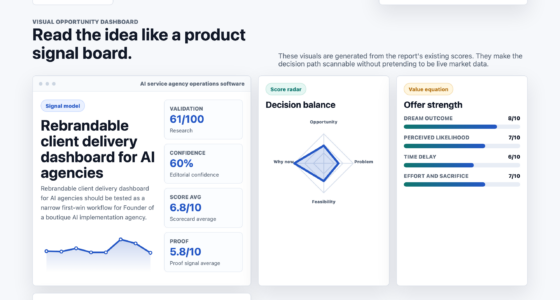

📊 Full opportunity report: Jack Clark Says It Out Loud — Reading the Co-Founder’s 60%/2028 Estimate on Automated AI R&D on ThorstenMeyerAI.com — validation score, market gap, and execution plan.

Get the latest gadgets delivered free — and shop member deals
- Fast, free delivery on millions of items
- Access to Prime Big Deal Days deals on October 6–7
- Prime Video, Amazon Music and more included
TL;DR
Jack Clark, Anthropic co-founder and head of policy, publicly estimates over 60% probability that AI systems capable of autonomously building their own successors could emerge by 2028. This is the first time a senior frontier-lab leader has publicly assigned a specific probability and timeline in an official capacity, signaling significant implications for AI policy and safety.
Jack Clark, co-founder and head of policy at Anthropic, publicly estimated there is a more than 60% chance that AI systems capable of autonomously developing their own successors will emerge without human involvement by the end of 2028. This marks the first time a senior frontier-lab leader has made such a specific probability estimate in an official capacity, carrying significant policy implications.
On May 4, 2026, Clark published Import AI #455, explicitly stating his assessment that there is a ‘likely chance (60%+)’ that autonomous AI R&D — where AI systems can train their own successors without human input — will occur by 2028. Clark’s statement is notable because it is a probabilistic forecast made publicly by a high-ranking official within a frontier AI lab, a move that underscores the seriousness of the timeline and its potential societal impact.
Clark’s estimate is based on observed rapid improvements in AI capabilities related to coding, research reproduction, and system management, alongside the significant investment from major AI labs targeting autonomous AI development. The statement reflects a policy position that could influence regulatory and safety considerations as the field advances.
Sixty percent
by twenty-twenty-eight.
A frontier-lab co-founder publishes a probabilistic forecast on automated AI R&D arrival. The institutional weight exceeds the analytical weight.
May 4, 2026 · Import AI #455 contains a single sentence that constitutes one of the most consequential public statements ever made by a frontier-lab leader on takeoff timelines. The fact of the statement matters as much as its content. The AGI debate is now closed for the people who would know. The question is what we do during the window the forecast describes.
Clark fills the empty seat.
The takeoff-timeline forecasting discourse has been continuous since 2022 but conducted almost entirely by researchers, ex-employees, and outside commentators. No sitting frontier-lab co-founder had published a numerical probability on a specific takeoff threshold within a specific timeframe. Until May 4, 2026.
Public forecasts create commitments.
Senior executives publishing probabilistic forecasts create operational obligations even when presented as personal analysis. Anthropic must now act as if the forecast is approximately right — internally, regulatorily, and in coordination with peers.
Five disagreements. Five different magnitudes.
Not every credible observer will share Clark’s 60%/2028. The honest disagreement isn’t about whether AI capability is improving — it’s about whether the curve continues, whether compute supply binds first, whether shocks intervene.
Four stakeholders. Four obligations.
The Clark essay doesn’t change capability trajectory. What it changes is the public-domain epistemic situation. Anyone modeling AI deployment must now account for the institutional position.
The AGI debate is now closed for the people who would know. The question that remains is what we do during the window in which we still have time to act.
Implications of a Senior Leader’s Autonomous AI Forecast
This statement by Clark signals a shift in the public discourse on AI timelines, as it is the first time a top frontier-lab official has publicly assigned a specific probability and timeline to autonomous AI development. It underscores the urgency policymakers and regulators should assign to AI safety and governance, given the high stakes involved. The institutional weight of Clark’s estimate suggests that AI safety and risk mitigation strategies may need to accelerate to prepare for a potential breakthrough within the next few years.
As an affiliate, we earn on qualifying purchases.
Background on AI Takeoff Timelines and Policy Discourse
Since 2022, discussions around AI takeoff timelines have been primarily driven by researchers, forecasters, and outside commentators, with estimates ranging from 2027 to beyond 2030. Prominent figures like Ajeya Cotra and Daniel Kokotajlo have provided private forecasts, but no senior frontier-lab executive had publicly offered a specific probability estimate within an official capacity until Clark’s statement. Historically, figures like Geoffrey Hinton have spoken out on AI risks, but Clark’s estimate is notable for its institutional backing and policy weight.
Clark’s statement follows a period of intense investment and rapid progress in AI capabilities, especially in areas like code generation and research automation, fueling concerns about the possibility of fully autonomous AI systems emerging sooner than expected.
“There is a likely chance (60%+) that no-human-involved AI R&D — an AI system capable of autonomously building its own successor — happens by the end of 2028.”
— Jack Clark
AI research and development software
As an affiliate, we earn on qualifying purchases.
As an affiliate, we earn on qualifying purchases.
Uncertainties Surrounding Clark’s Autonomous AI Timeline
While Clark’s estimate is explicit, the actual pace of AI development remains uncertain. The probability assessment is subjective and based on current observed trends, which could accelerate or slow down. It is also unclear how regulatory, safety, or technical challenges might influence the timeline, and whether other unforeseen factors could alter the trajectory.
autonomous AI system development kit
As an affiliate, we earn on qualifying purchases.
As an affiliate, we earn on qualifying purchases.
Next Steps for AI Policy and Industry Response
Policymakers and AI developers will likely scrutinize Clark’s forecast, potentially accelerating safety research and regulatory discussions. Public statements from other leaders in the field may follow, clarifying institutional positions. Monitoring progress in AI capabilities and investment trends over the coming months will be critical to assess whether the 2028 timeline remains plausible.
As an affiliate, we earn on qualifying purchases.
Key Questions
What does Clark’s 60% estimate mean for AI safety?
The estimate suggests a significant probability that autonomous AI systems could emerge within the next few years, raising urgent questions about safety, control, and regulation.
Why is Clark’s statement considered a policy move?
Because Clark is a high-ranking official communicating an institutional position, which influences regulatory and societal expectations for AI development.
Has any other AI leader made a similar public forecast?
Not publicly in an official capacity with a specific probability estimate; Clark’s statement is unique in its explicit probabilistic forecast from a senior frontier-lab executive.
What are the risks if the timeline accelerates or slows down?
If faster, safety and control challenges could become urgent; if slower, it might delay necessary safety measures. Both scenarios require careful policy planning.
How might this statement impact AI regulation?
It could prompt regulators to prioritize AI safety measures, investment in safety research, and international cooperation to prepare for potential breakthroughs.
Source: ThorstenMeyerAI.com
Fall Picks
fall essentials
As an affiliate, we earn on qualifying purchases.