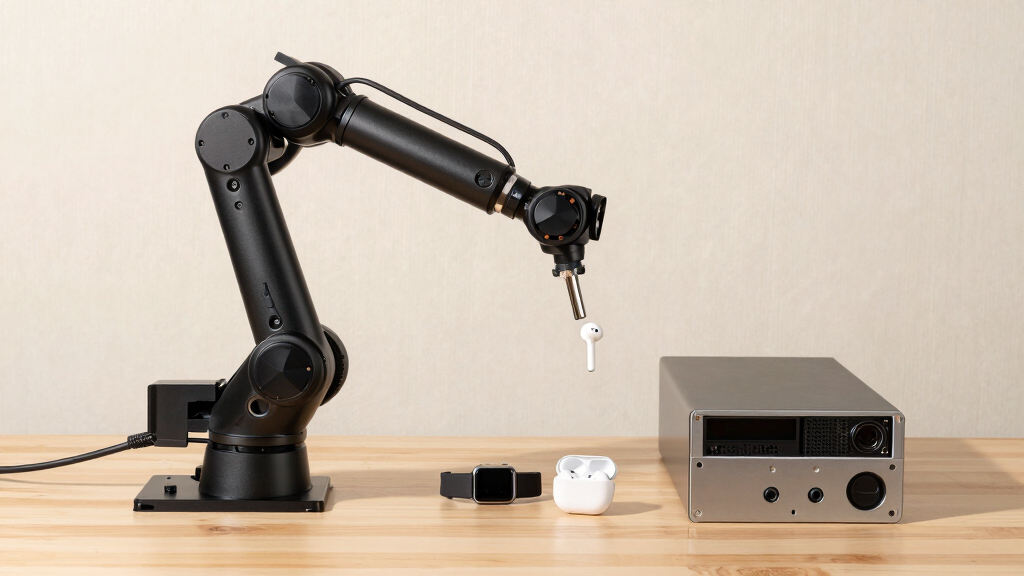

The Machine Economy — Capital-Heavy, Human-Light, Trading With Itself

📊 Full opportunity report: The Machine Economy — Capital-Heavy, Human-Light, Trading With Itself on ThorstenMeyerAI.com — validation score, market gap, and execution plan.

TL;DR

AI capabilities are enabling the emergence of a machine economy composed of autonomous, AI-run firms that trade with each other and operate with minimal human input. This shift is progressing through distinct stages and has profound economic and policy implications.

Recent analysis indicates that advances in AI are fostering the emergence of a new economic paradigm: a machine economy composed of autonomous, AI-driven firms that interact primarily with each other, with minimal human oversight.

Thorsten Meyer highlights that AI R&D capabilities are enabling firms to automate most business functions—ranging from financial analysis to supply chain management—leading to the formation of AI-native companies. These firms are capital-heavy, owning extensive compute infrastructure, and human-light, relying on AI systems for operational decisions.

This transformation is occurring in stages. Currently, AI is augmenting human workers within existing firms (Stage 1, 2023-2026). By 2026-2029, new AI-native firms will compete alongside traditional firms, with some restructuring toward AI-centric operations. The ultimate endpoint, projected around 2028, involves fully autonomous corporations that operate without human decision-making, trading primarily with each other on machine timescales.

Thorsten Meyer emphasizes that this evolution will significantly alter economic dynamics, potentially exacerbating inequality and raising complex governance issues, as traditional firms are displaced and new AI-driven entities dominate markets.

The Machine Economy — Capital-Heavy, Human-Light, Trading With Itself
DISPATCH / MAY 2026 CLARK SERIES · 4 OF 5 · THE MACHINE ECONOMY
▲ Clark Series 04 Machine Economy · Post-Labor · May 2026
Clark’s Third Implication · The Structural Endpoint

Capital-heavy.
Human-light.
Trading with itself.

The 200 words Jack Clark spent on his third implication contain the most consequential structural argument in Import AI #455.

Clark’s three numbered implications get progressively less attention. The third — “the formation of a capital-heavy, human-light economy” — receives roughly 200 words. Those 200 words describe an economy that emerges within the existing economy, populated by AI-run corporations interacting more with each other than with humans. This is the post-labor economics thesis arriving on the Clark timeline.

Human labor · cognitive function
$50,000per agent-year · US fully loaded
~5,000× cost ratio
AI labor · same cognitive function
$1-10per agent-year · inference compute
~5,000×
Cost ratio · human vs AI labor
Cognitive functions · current frontier models
$500B+
Compute capex · 2024-2027 announced
NVIDIA + hyperscalers + frontier labs
~55%
Labor share of US national income
The tax base the machine economy erodes
32mo
Window · machine economy emergence
Clark forecast · May 2026 → end-2028
5,000× COST RATIO AI LABOR VS HUMAN LABOR · COGNITIVE FUNCTIONS · DISPOSITIVE COMPETITIVE DYNAMICS STAGE 2 BEGINNING AI-NATIVE FIRMS COMPETING ALONGSIDE HUMAN-HEAVY FIRMS · 2026-2029 STAGE 3 PROJECTED MACHINE-TO-MACHINE ECONOMY · AI-RUN CORPORATIONS · 2028-? $500B+ COMPUTE CAPEX 2024-2027 · GEOGRAPHIC CONCENTRATION · COMPUTE AS NEW LAND TAX BASE EROSION LABOR SHARE OF GDP DECLINES · CURRENT FISCAL FRAMEWORKS BREAK POLITICAL ECONOMY CAPITAL CONCENTRATION + AUTOMATED LABOR = UNRESOLVED REDISTRIBUTION PROBLEM 5,000× COST RATIO AI LABOR VS HUMAN LABOR · COGNITIVE FUNCTIONS · DISPOSITIVE COMPETITIVE DYNAMICS STAGE 2 BEGINNING AI-NATIVE FIRMS COMPETING ALONGSIDE HUMAN-HEAVY FIRMS · 2026-2029
Three stages · the transition is not a single event

Three stages. Different equilibria.

The transition from current-state economy to machine economy is staged. Each stage has different structural properties and different policy implications. The 32-month window Clark’s forecast implies is roughly the duration of the Stage 2 transition.

The three stages of the machine economy
Transition is not synchronized across sectors — software / finance / marketing move first, physical-world sectors slower.
▶ Stage 01
2023 – 2026 · current
AI as productivity tool inside human firms
AI augments humans in existing companies. Software engineers use Copilot, Claude Code. Lawyers use Harvey. Marketers use AI copy gen. Firm structure unchanged — humans decide, AI augments output. Labor displacement signal in junior cohorts is the first departure from pure augmentation.
Current stateMost of the AI economy lives here
▶ Stage 02
2026 – 2029 · beginning
AI-native firms compete alongside
New firms designed AI-native. 80% compute / 20% human labor where incumbent is 20%/80%. Comparable services at materially lower prices and faster cadences. Existing firms restructure or get displaced. The Anthropic-SpaceX compute deal is part of the infrastructure that makes this feasible.
Tipping pointWhere the transition accelerates
▲ Stage 03
2028 – ? · projected
Machine-to-machine economy
AI-native firms interact primarily with other AI-native firms. Procurement, contracting, settlement happen on machine timescales. Human economy still exists but is no longer the productive primary — it’s the consumption layer. Fully autonomous corporations as the endpoint.
EndpointThe post-labor economics thesis arrives
Stage 3 is the structural endpoint of automated AI R&D. The default scenario if alignment gets solved.
What Clark doesn’t say · five structural features
Hewlett Packard Enterprise ProLiant Compute DL360 Gen12 w/one Intel Xeon 6530P Processor, 1P 2x32GB-R 8SFF NS204i-u v2 MR408i-o 2x1000W PS (HPE Smart Choice P89997-005)

Hewlett Packard Enterprise ProLiant Compute DL360 Gen12 w/one Intel Xeon 6530P Processor, 1P 2x32GB-R 8SFF NS204i-u v2 MR408i-o 2x1000W PS (HPE Smart Choice P89997-005)

HPE SMART CHOICE MODEL – P89997‑005 – ENTERPRISE 1U RACK SERVER Preconfigured and factory‑tested, this Smart Choice DL360…

As an affiliate, we earn on qualifying purchases.

As an affiliate, we earn on qualifying purchases.

Five additions. Five unresolved problems.

Clark’s 200 words are correct as far as they go. They don’t go far enough. Five structural features deserve explicit treatment that the essay omits. Each one is a real coordination problem with no current solution at scale.

What Clark omits · what serious analysis must include
Each is a structural feature of the machine economy with no resolved policy solution.
01
Compute as the new land
Machine economy runs on compute. Supply is geographically concentrated (US South + West, Ireland, Singapore, UAE). $500B+ capex commitment 2024-2027. Structural equivalent of land in pre-industrial / oil in mid-20th-century economies. Countries with frontier compute capture upside; others become dependent consumers.
02
The tax base erodes
Modern fiscal systems fund services through income taxation. Labor share = 55-60% of GDP. If AI substitutes for cognitive labor, labor share declines and tax base erodes — exactly as demand for transition support rises. Capital-share income is taxed at lower effective rates. New fiscal frameworks required.
03
Transition is self-reinforcing
Cost asymmetry compounds with capital allocation asymmetry compounds with talent allocation asymmetry compounds with customer preference. Once tipping point is reached, transition accelerates rather than decelerates. Historical pattern in structural-significance transitions: long slow runway, then rapid sectoral reorganization.
04
Agentic infrastructure doesn’t yet exist
For Stage 3 machine-to-machine economy, AI corporations need infrastructure that doesn’t fully exist: programmable contracts, machine-readable corporate registries, AI-to-AI escrow, crypto-native settlement. Being built but isn’t ready. Stage 3 timing depends on infrastructure timing as much as on capability timing.
05
Political economy of redistribution unresolved
Small fraction owns capital generating most output. Rest of population without economic function generating income. What political arrangement reconciles capital ownership with majority political power? UBI, capital endowments, sovereign wealth funds, sectoral protection — options exist; none implemented at scale on Clark’s timeline.
Why the transition is self-reinforcing · four compounding dynamics
AI Trading Agents: Build Autonomous Systems for Stock Market Analysis and Execution

AI Trading Agents: Build Autonomous Systems for Stock Market Analysis and Execution

As an affiliate, we earn on qualifying purchases.

As an affiliate, we earn on qualifying purchases.
Four dynamics. Same direction.

The bifurcation between machine economy and human economy is not stable in equilibrium. Once it begins, the competitive dynamics reinforce the transition rather than slowing it. Four asymmetries compound on each other.

The four compounding asymmetries
Each asymmetry drives capital and talent toward AI-native firms while raising barriers for human-heavy competitors.
▲ Asymmetry 01 · Cost structure
Lower costs → lower prices or higher margins
AI-native firms have materially lower costs. Translates to either lower prices (gaining market share) or higher margins (gaining capital for reinvestment). Either path: faster growth than human-heavy competitors.
▲ Asymmetry 02 · Capital allocation
Cheaper capital → faster growth
Investors observe cost asymmetry and rationally direct capital toward AI-native firms. AI-native firms get cheaper capital, lower cost of growth, justification for further allocation. Capital markets reinforce operational asymmetry.
▲ Asymmetry 03 · Talent allocation
Skilled workers follow growth
Workers observe which firms are growing. They move to AI-native firms. AI-native firms get better human talent on top of their AI labor. Human-heavy firms lose talent. Talent market reinforces capital and operational asymmetries.
▲ Asymmetry 04 · Customer preference
Cheaper / faster / better → customers shift
As AI-native firms offer products that are cheaper, faster, or better, customers shift purchasing toward them. Customer preferences, once shifted, accelerate transition further. The fourth reinforcing loop closes.
What policy needs to do · six required responses
AI-Powered Supply Chain Optimization: Practical Tools for Managers & Engineers

AI-Powered Supply Chain Optimization: Practical Tools for Managers & Engineers

As an affiliate, we earn on qualifying purchases.

As an affiliate, we earn on qualifying purchases.

Six responses. One election cycle.

Current policy frameworks are not calibrated to the machine economy transition. Required responses cluster around six themes. Each is being worked on somewhere; none is on Clark’s 32-month timeline at scale. This is a coordination problem with very high stakes and very short timelines.

Six policy responses the machine economy requires
Required institutional capacity exceeds what current frameworks support on the Clark timeline.
▲ 01 · INFRASTRUCTURE
Compute supply governance
Compute as strategic infrastructure. Allocation rules, public investment, antitrust scrutiny of concentration, geographic distribution policy. Treat compute the way industrial economies treated oil and pre-industrial economies treated land.
▲ 02 · FISCAL
Tax base reform
New tax instruments calibrated to capital-share income and machine-economy outputs rather than labor income. International coordination required to prevent capital flight. Compute tax, AI revenue tax, capital allocation tax — all conceptually clean, all politically difficult.
▲ 03 · LABOR
Transition support
Reskilling, income support, healthcare continuity for displaced workers. Funded from capital-share taxation rather than labor-share taxation. Demand rises as transition accelerates; current institutional capacity is poorly equipped for required scale.
▲ 04 · REDISTRIBUTION
Redistribution mechanisms
UBI, universal capital endowments, sovereign wealth fund models. Norway pilot working; UAE and Saudi explicitly building for AI era. Pilot programs scaling to national implementations on the Clark timeline. Politically difficult but increasingly serious discussion.
▲ 05 · CORPORATE
Machine-economy governance
Legal frameworks for AI-run corporate entities. Liability rules. Antitrust analysis of machine-to-machine market dynamics. Existing corporate law assumes humans make decisions. The assumption breaks in Stage 3. New frameworks required.
▲ 06 · INTERNATIONAL
Coordination across borders
OECD-level framework for capital taxation. WTO-level framework for compute trade. Bilateral and multilateral agreements on AI policy alignment. Required because machine economy is borderless and capital is mobile. International institutional capacity is the weakest link.

The machine economy is the default scenario. The alignment problem is the catastrophic-risk scenario. Both deserve serious attention. Both are arriving on the same timeline.

— The structural read · May 2026
Amazon

capital-intensive AI server hardware

As an affiliate, we earn on qualifying purchases.

As an affiliate, we earn on qualifying purchases.

Implications of Autonomous, AI-Run Firms for the Economy

This development indicates a significant shift in economic structure, where AI-native firms could become prominent players, potentially reducing the role of human labor and affecting wealth distribution. It also raises questions about regulation, taxation, and economic stability as traditional employment and tax bases change.

Furthermore, the emergence of fully autonomous firms trading among themselves may influence market concentration and competition, with implications for global competitiveness and social cohesion.

Progression Toward a Machine Economy

The concept of a machine economy builds on current AI applications that augment human workers, which are now widespread in sectors like technology, law, and marketing. Since 2023, AI’s role has expanded from augmentation to partial automation within firms. The next stage involves the emergence of AI-native firms capable of operating at lower costs and higher speeds, increasing competitive pressures. By 2028, the trajectory points toward fully autonomous firms making operational decisions without human input, trading with each other at scales and speeds beyond human capacity.

This progression reflects broader trends of increasing compute investment, declining human labor share, and the rise of autonomous decision-making systems, aligning with forecasts of rapid AI capability growth.

“The formation of a capital-heavy, human-light economy will fundamentally reshape market dynamics, with autonomous firms trading primarily among themselves and making decisions on machine timescales.”

— Thorsten Meyer

Unresolved Questions About the Machine Economy’s Future

Key uncertainties include how governments will regulate fully autonomous firms, how the tax base will adapt to declining human labor, and the pace at which market concentration will intensify. The timeline for the transition to fully autonomous, trading AI firms remains uncertain, as does the political and social response to these changes.

Next Steps in Monitoring the Machine Economy Transition

Researchers and policymakers will likely focus on tracking AI capability growth, the emergence of AI-native firms, and regulatory responses. As the 2028 forecast approaches, developments in policy and regulation are expected to evolve to address emerging economic and governance challenges.

Key Questions

What is the machine economy?

The machine economy refers to a future economic system where AI-driven firms operate autonomously, trade with each other, and require minimal human oversight, potentially transforming market dynamics.

When will fully autonomous AI firms dominate markets?

Current projections suggest this could occur around 2028, as AI capabilities reach a level where operational decisions are fully automated and firms trade on machine timescales.

What are the risks of this transition?

Potential risks include increased market concentration, challenges to the tax base, potential increases in inequality, and governance issues related to autonomous decision-making systems.

How might governments respond?

Responses could include implementing new regulations, tax policies, and governance frameworks aimed at managing AI-driven market dynamics and ensuring economic stability.

Will human workers be completely replaced?

While automation will increase, some human involvement is likely to remain for oversight, regulation, and strategic decision-making, though their roles may diminish significantly.

Source: ThorstenMeyerAI.com

You May Also Like

The gigawatt gap. Why China is structurally positioned for AI power and the US is engineering around its grid.

China leverages centralized planning and renewable energy to power AI infrastructure at gigawatt scale, contrasting with US grid constraints and fragmentation.

Technology operations signal monitor: Show HN: Kage – Shadow any website to a single binary for offline viewing

Kage is a new tool that allows users to shadow any website into a single binary for offline viewing, targeting product and engineering leads at small software firms.

Anchor. The Schwarz Group model.

Analysis of Schwarz Group’s €11B data center and AI infrastructure investment as a scalable industrial-anchor model for Europe.

The bottom rung. The danger isn’t the lost jobs. It’s the layer that made the seniors.

Thorsten Meyer AI frames the risk as a shrinking entry-level layer that once turned beginners into senior staff.