
TL;DR

Get the latest gadgets delivered free with Prime
- Fast, free delivery on millions of items
- Prime Video, Amazon Music and more included
- Member-only deals all year
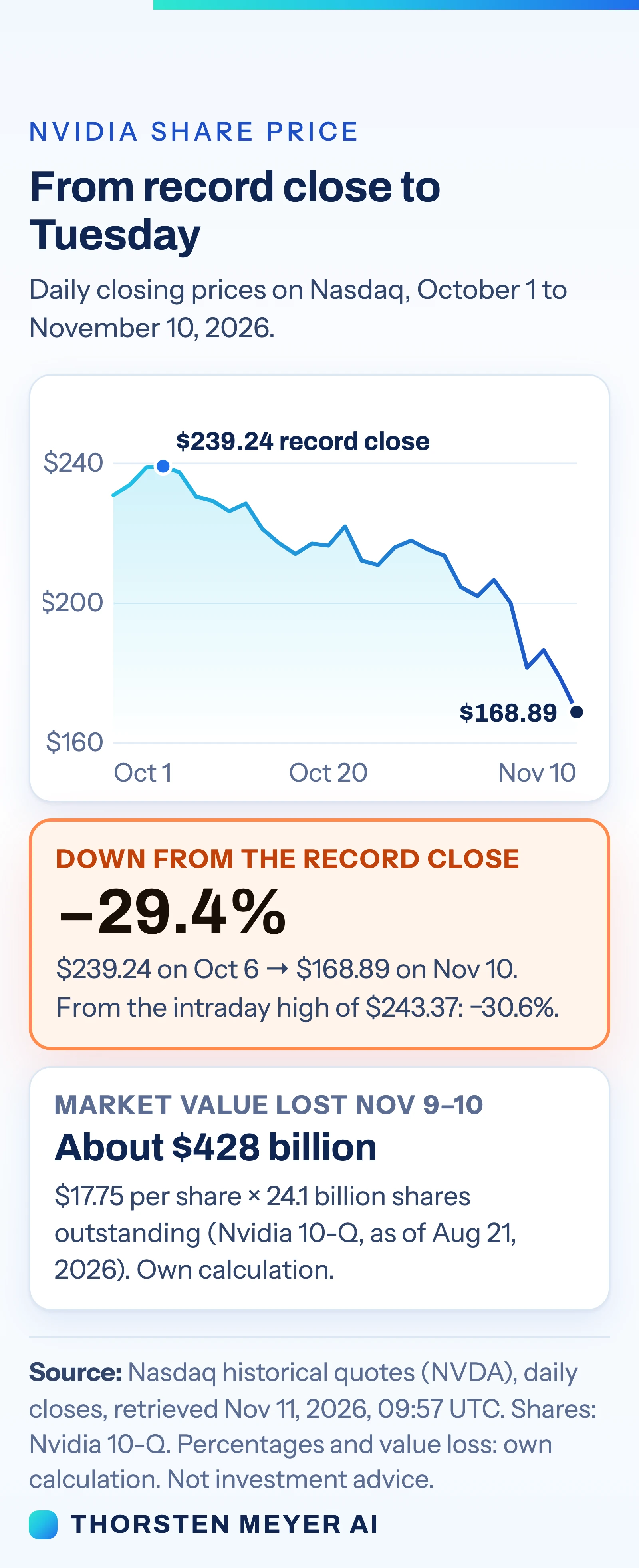
Nvidia closed at $168.89 on Nov. 10, 29.4% below its Oct. 6 record close. Market-wide concerns about AI data-center spending and inflation coincided with company-specific scrutiny, but available reporting does not establish how much each factor drove the decline.
Nvidia closed at $168.89 on Nov. 10, down 29.4% from its record closing price of $239.24 on Oct. 6, as a broad technology sell-off and several Nvidia-specific developments weighed on the stock. The decline matters beyond the company because Nvidia represented substantial shares of major market-tracking funds, though reporting available as of Nov. 10 does not establish the precise contribution of each factor.
The stock fell 5.47% on Nov. 10, following a 4.27% decline on Nov. 9. It had dropped 9.26% on Nov. 5, then rebounded 2.78% on Nov. 6. From its Nov. 4 close of $200.13 to its Nov. 10 close, Nvidia lost 15.6% across four trading sessions. These percentages are calculated from Nasdaq closing prices.
Between the Nov. 6 close of $186.64 and the Nov. 10 close, the share price fell $17.75. Using Nvidia’s reported 24.1 billion shares outstanding as of Aug. 21, the article’s calculation puts the associated decline in market value at about $428 billion. From the Oct. 6 record close, the $70.35 per-share decline corresponds to roughly $1.7 trillion using that same share count. These are estimates based on a fixed share count, not reported company losses.
Two sets of pressures were reported: concerns affecting technology and AI-related stocks broadly, and developments specific to Nvidia. The latter included a board investigation announced Nov. 8, a proposed shareholder class action filed Nov. 9, and scrutiny of a Nvidia customer over export controls. The available source material does not provide enough detail to assess the claims or the investigation’s findings.
Nvidia’s Weight in Major Indexes
Nvidia’s stock decline can affect investors who hold broad market funds as well as those who own Nvidia directly. As of Nov. 9, the company accounted for 6.64% of SPY, an S&P 500 tracker, and 7.10% of QQQ, a Nasdaq-100 tracker. Those weights mean a large move in Nvidia can put pressure on the funds, although their overall performance also depends on their other holdings.
CNBC reported on Nov. 10 that Nvidia “dragged down the three major averages.” The stock’s fall also illustrates how expectations for AI infrastructure spending and financing conditions can affect market sentiment toward a company whose chips are used in data centers. The reporting does not quantify how much Nvidia’s move changed broader indexes or establish that data-center spending itself had slowed.
For businesses and technology users, the stock price alone does not show whether Nvidia’s products, supply, or customer demand have changed. The share decline is a market signal, not direct evidence of a change in the availability or performance of AI systems.
Products Worth Considering

Apple AirPods Pro 3 Wireless Earbuds with Active Noise Cancellation

Amazon Kindle Paperwhite Signature Edition (12th Generation, 2024), 32 GB, Metallic Raspberry

Bose QuietComfort True Wireless Earbuds with Active Noise Cancellation, Bluetooth 5.3, USB-C Charging, IPX4, Black
As an affiliate, we earn on qualifying purchases.
From October Record to November
Nvidia reached a record close of $239.24 on Oct. 6. Yahoo Finance reported that the shares settled just below an intraday record set that day, when the company’s market value reached $5.84 trillion. The stock then weakened unevenly. It fell 4.22% on Oct. 30 and closed at $200.13 on Nov. 4 before the steeper moves in early November.
AFP attributed the broader technology selling to fears of a slower AI data-center buildout following the U.S. midterm elections. The Motley Fool reported market concerns that the incoming Congress could be more hostile to AI development and noted that several incoming governors had announced plans for data-center construction moratoriums. Those are reported expectations and proposals; they do not establish that construction has stopped or that federal policy has changed.
On Nov. 10, AFP linked a market decline to October inflation data that slowed less than expected and raised expectations of Federal Reserve rate hikes. CNBC reported that the consumer price index rose 0.4% in October, compared with economists’ 0.3% expectation, while the Nasdaq fell 0.7%. Reuters also cited uncertainty about the AI outlook. Higher borrowing costs can affect companies financing infrastructure, but the reports do not show a direct measure of their effect on Nvidia’s sales or valuation.
Drivers Still Cannot Be Measured
The available reporting does not assign a precise share of Nvidia’s decline to inflation, interest-rate expectations, data-center spending concerns, the board investigation, the shareholder lawsuit, or export-control scrutiny. The timing of those developments and the price moves is reported, but timing alone cannot show how investors weighed each one.
The source material does not describe the board investigation’s scope or conclusions, the lawsuit’s detailed allegations or legal status beyond its filing, or the identity and circumstances of the customer under export-control scrutiny. It also does not confirm that the reported policy concerns will result in data-center construction restrictions. Market prices may move again after the Nov. 10 close.
Earnings Report Due November 17
Nvidia is scheduled to report its third-quarter results on Nov. 17. The report will provide a new company update after the sharp early-November share decline. Until then, the figures in this article describe the market through the Nov. 10 close, and the reported explanations remain factors cited by news organizations rather than a definitive accounting of the move.
Key Questions
How far was Nvidia below its record close?
Nvidia closed at $168.89 on Nov. 10, 29.4% below its record closing price of $239.24 on Oct. 6. The comparison is based on closing prices.
How much market value did Nvidia lose?
The source article estimates about $428 billion between the Nov. 6 and Nov. 10 closes, using the $17.75 share-price decline and 24.1 billion shares outstanding. It estimates roughly $1.7 trillion from the Oct. 6 record close using the same share count. These are calculations, not company-reported losses.
What factors were linked to the decline?
Reports cited broad concerns about AI data-center investment and higher-than-expected inflation, alongside Nvidia-specific developments: a board investigation, a proposed shareholder class action, and scrutiny of a customer over export controls. The available reporting does not measure the impact of each factor.
When is Nvidia’s next earnings report?
Nvidia is scheduled to report its third-quarter results on Nov. 17, 2026.
Source: Thorsten Meyer AI