TL;DR
A November 2026 METR assessment found that Anthropic is likely improving model capabilities on well-specified tasks at about twice its earlier rate, with high uncertainty; the work described relied primarily on AI assistance to researchers. Google DeepMind has also reported a specific efficiency gain from AlphaEvolve. These examples support the possibility that AI can help improve future AI systems, but they do not establish a self-sustaining cycle or its eventual speed.
AI assistance may be speeding parts of AI research, according to an assessment of Anthropic published November 5 by the independent evaluation organization METR. METR judged that Anthropic is likely improving model capabilities on well-specified tasks at around twice its earlier rate, but emphasized substantial uncertainty; the work it assessed was primarily researchers using AI assistance. The finding gives a concrete, qualified example of AI contributing to the development of more capable systems.

Get the latest gadgets delivered free with Prime
- Fast, free delivery on millions of items
- Prime Video, Amazon Music and more included
- Member-only deals all year
METR said it would not be surprised if the acceleration were as low as 1.3 times or as high as three times. Those figures describe METR’s uncertain assessment of the rate of capability improvement on well-specified tasks. They do not mean AI is independently conducting all research, nor do they establish a general rate for the industry. METR redacted much of the evidence it considered most informative, limiting what outside readers can inspect.
A separate example comes from Google DeepMind. The company reported that its system AlphaEvolve improved a matrix-multiplication component used in Gemini, making that component 23% faster. DeepMind said the change reduced Gemini’s overall training time by 1%. This is a company-reported result for a specific component and training process, rather than evidence that all AI research is accelerating at the same pace.
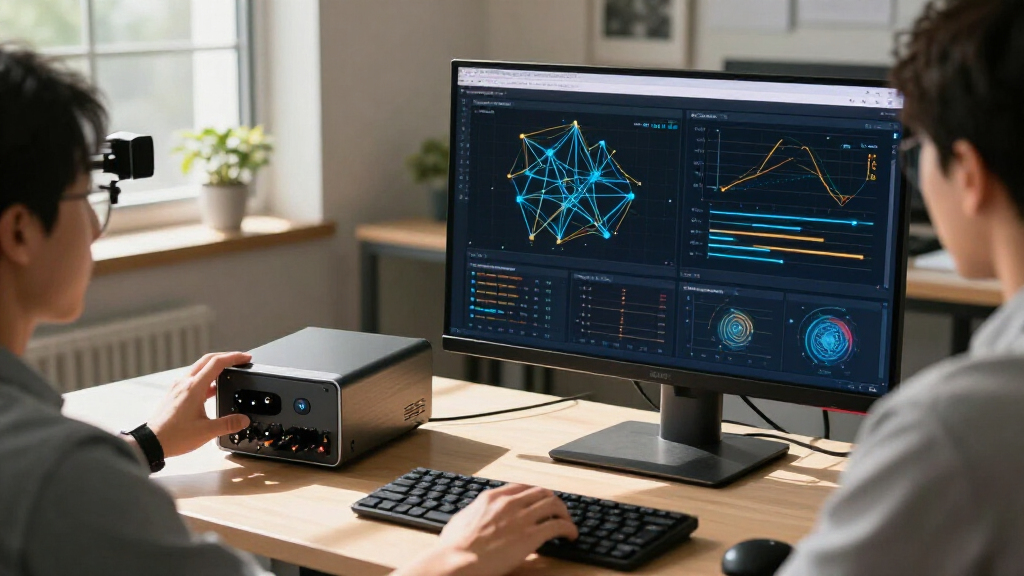
The proposed cycle is straightforward: a model helps researchers write code, suggest experiments or examine results; testing filters out changes that do not hold up; and validated improvements may be used in a stronger model that can assist with later work. The cycle is a schematic argument, not a measured description of how any laboratory currently operates end to end. The examples show assistance and an efficiency gain, but do not establish that a model has taken over the full process.

How Research Gains Could Compound
If AI tools help researchers make reliable improvements, they could reduce the time or computing needed to develop later systems. Efficiency gains can compound in a simple illustration: three independent savings of 10% each would leave a task requiring about 73% of its original compute. Under the same compute budget, that would allow roughly 37% more of those tasks. This is an illustration, not a forecast, and it assumes the savings are independent and apply to comparable work.
The broader relevance is that faster or less costly research could change how quickly organizations develop AI and how businesses plan around it. But technical capability alone does not determine who can use these systems, who controls the infrastructure or how benefits are distributed. Those outcomes also depend on deployment choices and institutions. The available examples do not resolve those questions or show that dramatic acceleration is inevitable.
Products Worth Considering

Amazon Kindle Scribe (32GB) with Premium Pen, Tungsten (Like-New)

Apple MacBook Air 15-inch Laptop with M5 Chip, 16GB Memory, 512GB SSD, Liquid Retina Display, and Touch ID (Midnight)

Apple Watch Series 10 GPS 46mm with Silver Aluminum Case and Blue Cloud Sport Loop
As an affiliate, we earn on qualifying purchases.
From AI Assistance to Successor Systems
AI research involves more than generating a promising idea. Researchers must inspect prior work and existing code, prepare experiments, account for compute and data, investigate failures and check whether apparent gains persist. A reported improvement can be misleading if tests differ, resources are not comparable or results fail to repeat. Reliable evaluation is therefore part of the research task, not merely a final formality.
The source essay points to several possible constraints on an AI-assisted research cycle: experiment time and hardware, the gap between small tests and large systems, choosing productive research directions, continuity of work and data quality. A system that helps with one coding or analysis step may still require substantial human oversight and may not transfer its results to larger training runs. The pace of progress could consequently vary across tasks and over time.
Google DeepMind’s AlphaEvolve example, reported in May 2025, predates METR’s November 2026 assessment and illustrates a particular engineering contribution. Together, the reports provide distinct pieces of evidence: one assessment about the rate of capability improvement at Anthropic, and one company-reported efficiency result for Gemini training. Neither alone measures a complete, repeating loop in which each model autonomously builds its successor.
“It “would not be surprised” by 1.3x or 3x.”
— METR
Limits of the Available Evidence
The public account does not include much of the evidence METR considered most informative, because it was redacted. The assessment is also explicitly uncertain and concerns improvements on well-specified tasks; the material does not establish how broadly its estimate applies to other kinds of research or other AI developers. The degree of human supervision involved in the assessed work is not fully detailed in the available source.
It also remains unclear how often AI-suggested research gains survive independent checks, scale from small experiments to full systems and produce lasting improvements. The AlphaEvolve figures are reported by Google DeepMind, and the source does not provide enough detail here to independently assess the full measurement setup. Neither report demonstrates that AI systems can choose research priorities, verify all results and build successive models without people.
What Future Evaluations Need to Show
The next useful evidence would clarify what tasks AI systems perform in research, how much human involvement they require, and whether measured gains persist across repeated tests and larger systems. More transparent methods and results would help outside evaluators judge both the size of any acceleration and its limits. The source material does not identify a scheduled follow-up assessment or a specific date for new results.
For now, the reported findings support a cautious conclusion: AI is already assisting some research work, and one company has reported a measurable training efficiency gain. Whether these examples develop into a sustained cycle that materially accelerates the creation of future AI systems remains an open question.
Key Questions
What did METR assess at Anthropic?
METR assessed AI research acceleration and judged that Anthropic is likely improving model capabilities on well-specified tasks at around twice its earlier rate. It described the estimate as highly uncertain.
Does the assessment show that AI is building AI by itself?
No. The work METR described was primarily AI assistance to researchers. The source presents a repeating model-improvement cycle as a schematic argument, not a measured process at a laboratory.
What did AlphaEvolve change?
Google DeepMind reported that AlphaEvolve made a matrix-multiplication component used in Gemini 23% faster, reducing Gemini’s overall training time by 1%.
How certain is the reported acceleration?
METR expressed high uncertainty and said it would not be surprised by an estimate ranging from 1.3 times to three times. The assessment concerns specified tasks and should not be read as a confirmed industry-wide rate.
What could slow AI-assisted research?
Potential constraints include experiment time and hardware, whether small-scale results transfer to large systems, research direction, continuity and data quality. The source does not quantify how much each factor limits progress.
Source: Thorsten Meyer AI