
This checklist is for home-network enthusiasts planning an upgrade, troubleshooting wired connections, or adding shared storage. It covers wireless, wired, and storage gear so you can focus on the parts of your setup that need attention.

Get the latest gadgets delivered free with Prime
- Fast, free delivery on millions of items
- Prime Video, Amazon Music and more included
- Member-only deals all year
The sections follow the listed picks and advice slots: a Wi-Fi 7 router, a mesh system, a multi-gigabit switch, cable testing, a USB-C Ethernet adapter, and network attached storage. Each section helps you consider fit and compatibility before choosing a product.
Start with the part of your network that creates the most friction. Check your existing devices, connection types, and available space, then use the look-for list to compare options against your needs.
Wi-Fi 7 Router
A router is the central choice for a wireless upgrade, so begin by checking what your existing devices and internet connection can use. The NETGEAR Orbi 970 Series WiFi 7 Mesh System (3-Pack) is the listed pick. Consider whether a three-piece system fits your home and where its units could be placed; a product name alone does not establish coverage for your particular layout.
A common buying mistake is choosing the newest wireless generation without checking client compatibility or the rest of the network. Make an inventory of the devices you expect to connect, and confirm the product’s supported connections and setup requirements before buying. Also consider the physical placement of each unit and whether your current modem or gateway can work with the system. Match the equipment to your home’s layout and the devices you actually use, rather than relying on the generation label alone.
What to look for:
- Confirm compatibility with your modem or gateway.
- Check which wireless standards your devices support.
- Plan placement for all three units.
- Review the product’s setup and connection requirements.
NETGEAR Orbi 970 Series WiFi 7 Mesh System (3-Pack)
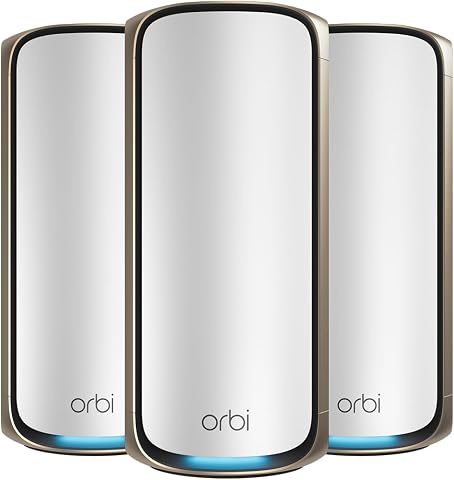
The NETGEAR Orbi 970 Series is a 3-pack WiFi 7 mesh system (router plus 2 satellites) providing up to 10,000 sq ft of coverage and support for up to 200 connected devices. It delivers speeds up to 27 Gbps using patented Quad-Band technology with a dedicated backhaul, and includes 10 Gig and 2.5 Gig wired ports for high-performance connections.
Pros:
- Massive whole-home coverage up to 10,000 sq ft with no dead zones
- Very fast WiFi 7 speeds up to 27 Gbps with dedicated backhaul
- High-speed wired options including 10 Gig ports
- Easy guided setup and remote management via the Orbi app
Cons:
- NETGEAR Armor security requires a paid subscription after 30-day trial
- Real-world speeds vary with devices and internet plan
- Only for use in the US
Best for: Home users planning a Wi-Fi 7 mesh upgrade.
Not ideal for: Setups where a three-unit system does not fit the space or device needs.
Bottom line: Check compatibility and placement before choosing this three-pack.
Mesh Wi-Fi System
Mesh equipment can be a useful way to plan wireless access across multiple parts of a home. The listed pick is the NETGEAR Orbi Pro WiFi 6 Tri-Band Mesh System with Router and 3 Satelli. The product name identifies a router and three satellites, so consider whether you have suitable places for each unit and whether that arrangement makes sense for your home.
Do not choose a mesh system solely because the number of included units seems generous. Check the exact product listing for the complete model name, supported features, setup requirements, and compatibility with your internet equipment. A frequent mistake is overlooking how placement, walls, and the devices connecting to the network affect the practical setup. Map your space and identify where you want wireless access, then compare that plan with the system’s requirements. Confirm the product details before ordering, especially because the supplied name appears truncated.
What to look for:
- Verify the full product name and model.
- Confirm compatibility with your modem or gateway.
- Plan locations for the router and three satellites.
- Check supported wireless standards for your devices.
- Review setup requirements before purchase.
NETGEAR Orbi Pro WiFi 6 Tri-Band Mesh System with Router and 3 Satellites (SXK80
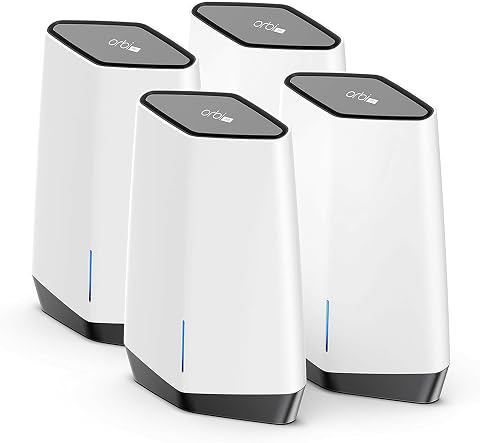
This tri-band WiFi 6 mesh system includes one router and three satellite units for business, home-office, or small-business networks. It supports up to 100 devices, offers VLAN and QoS features, and is compatible with WiFi 5 devices.
Pros:
- Includes one router and three satellite units for mesh coverage.
- Tri-band WiFi 6 supports high data throughput and a larger number of connected devices.
- Supports VLAN, QoS, WPS, and WPA2/WPA3 security.
- Compatible with legacy WiFi 5 devices.
Cons:
- The stated coverage differs between the title and product details.
- The product details list six ports but do not specify their individual types.
Best for: Buyers planning a multi-unit Wi-Fi 6 setup.
Not ideal for: Anyone who has not confirmed the complete model and compatibility.
Bottom line: Verify the exact listing and map unit placement first.
Multi-Gigabit Switch
A multi-gigabit switch is an advice-only slot in this checklist, so choose by the wired devices and connections you need to bring together. Count the devices that will connect directly, such as computers, storage, or network equipment, and leave room for additions you already expect. Port count and speed should follow your actual connections, not an assumption that every device needs the same capability.
A common mistake is buying a switch without checking the speeds supported by the router, connected devices, and cabling. Confirm that the intended link between each pair of devices can support the connection you want, and check whether the switch needs any features for your setup. Consider its physical location, power needs, and available space. Trace the wired path from each device to the router or switch before selecting a model, and verify the ports and capabilities in the manufacturer’s listing.
What to look for:
- Count current wired devices and planned additions.
- Match port speeds to connected equipment.
- Check the uplink connection to your router.
- Verify cabling supports the intended links.
- Confirm power and placement requirements.
Ethernet Cable Tester
A cable tester helps you assess Ethernet runs when a wired connection is unreliable or a new installation needs checking. The listed pick is the Fluke Networks MicroScanner2 Copper Cable Verifier with IntelliTone To. Its name is truncated, so confirm the complete model and included functions in the product listing before deciding whether it fits your troubleshooting tasks.
One common mistake is assuming every tester checks every cable type or performs the same diagnostic functions. Identify the cables and connectors you need to inspect, then compare those with the device’s documented support. Consider who will use it and whether the controls and included accessories suit that person and the work at hand. Verify the exact capabilities and what comes in the package; do not infer them from the product name. If you only need to check a basic connection, compare the listed functions with that specific task before choosing a more involved tool.
What to look for:
- Confirm the full model name and included functions.
- Check support for your cable and connector types.
- Match diagnostic features to your troubleshooting tasks.
- Review included accessories and instructions.
- Consider who will use and carry the tester.
Fluke Networks MicroScanner2 Copper Cable Verifier with IntelliTone Toning

The MicroScanner2 is a cable tester that displays cable length, wiremap, cable ID, and distance to faults on a single screen. It supports troubleshooting for RJ11, RJ45, coax, and tests 10/100/1000Base-T and VoIP networks.
Pros:
- Comprehensive cable testing features
- Displays multiple diagnostics on one screen
- Supports various cable types and network speeds
Cons:
- Limited to copper cable verification
- No mention of battery life or durability
- Requires some technical knowledge to interpret results
Best for: Users who need to inspect Ethernet cabling.
Not ideal for: Anyone whose cable types or required checks are unsupported.
Bottom line: Confirm the complete listing matches your cable-testing needs.
USB-C Ethernet Adapter
This slot lists USB-A and USB-C Data Blocker Charging Adapters, a name that does not identify an Ethernet adapter. Check the full product listing carefully before buying: confirm that it provides Ethernet connectivity and the port type you need. A data blocker or charging adapter may not serve the same purpose as an adapter that connects a computer to a wired network.
A common buying mistake is relying on a broad category label instead of checking the actual ports and supported functions. Identify the computer’s available USB ports, the Ethernet connection you want, and any operating system requirements. Then verify that the listing explicitly describes a network connection and names the supported interfaces. Match both ends of the connection and confirm the product’s role before ordering. If the listed item only provides charging or data blocking, it will not meet an Ethernet-adapter requirement.
What to look for:
- Confirm the product explicitly supports Ethernet.
- Match USB-A or USB-C to your computer’s port.
- Check the Ethernet connector type.
- Verify operating system compatibility.
- Read the full listing to distinguish networking from charging or data blocking.
USB-A and USB-C Data Blocker Charging Adapters

These USB-A and USB-C data blockers allow charging while physically preventing data transfer and syncing. The set supports USB-A to USB-C charging up to 2.4A and USB-C to USB-C charging up to 240W PD, and is designed for use with compatible phones and other electronic devices.
Pros:
- Physically blocks data transfer while allowing charging
- Supports USB-C Power Delivery up to 240W
- Includes USB-A and USB-C options for compatible devices
Cons:
- Does not support data transfer or syncing
- Compatibility depends on the device and connector type
Best for: Buyers who need a wired network connection over USB.
Not ideal for: Anyone expecting a data blocker or charging adapter to provide Ethernet.
Bottom line: The listed name does not establish Ethernet support; verify the product details.
Network Attached Storage
Network attached storage provides a place to consider for shared files and other data on a home network. The listed pick is the UGREEN NAS DXP8800 Ultra 8-Bay Network Storage Server. An eight-bay server calls for planning: consider where the unit will sit, what drives or other components the system requires, and how you intend to connect it to your network.
A common mistake is treating the server name as a complete description of what comes in the box or how much usable storage it provides. Check the listing for included drives, supported drive types, setup requirements, and network connections. Think through how many people or devices need access and whether the planned storage arrangement suits your needs. Confirm the full configuration before purchase, including any separate components you may need. Also plan a backup approach; network storage should not be your only copy of important files.
What to look for:
- Confirm whether drives are included.
- Check supported drive types and configuration options.
- Review network connections and setup requirements.
- Plan physical space for an eight-bay unit.
- Decide how important files will be backed up.
UGREEN NAS DXP8800 Ultra 8-Bay Network Storage Server

The DXP8800 Ultra is an 8-bay NAS for business teams and studios, with dual 10GbE ports, Thunderbolt 4, and USB 3.2 Gen 2 for fast file sharing and large media transfers. It supports virtual machines, containers, and other applications, with up to 272TB of storage, RAID options, and local AI tools for organizing photos and creative assets.
Pros:
- Dual 10GbE and Thunderbolt 4 support fast transfers and team access.
- Supports virtual machines, Docker containers, and other applications.
- Eight drive bays and two NVMe slots provide expandable storage.
- Local AI features help organize and find photos and creative assets.
Cons:
- Drives are not included.
- Expanding memory beyond 8 GB requires a separate upgrade.
Best for: Home users planning a multi-drive network storage setup.
Not ideal for: Buyers who need a compact, ready-to-use single-drive solution.
Bottom line: Verify drive inclusion, configuration, and backup plans before buying.
Buy in an order that follows your needs: first address the router or mesh setup, then add wired switching or cable testing where your connections call for it. Consider the USB Ethernet option only after verifying the listed product actually provides Ethernet. Plan storage after confirming the server configuration and the drives or other components required. Prioritize the bottleneck you have identified instead of replacing every part at once.
A home network upgrade is easier to manage when each purchase has a clear job. Check model details, device compatibility, port types, and placement before you order, and keep a record of what each item is meant to improve. Work one step at a time, and your checklist can guide a practical upgrade that fits your setup.