
📊 Full opportunity report: Liquid vs Air Cooling for 24/7 Inference Rigs on ThorstenMeyerAI.com — validation score, market gap, and execution plan.

Get the latest gadgets delivered free — and shop member deals
- Fast, free delivery on millions of items
- Access to Prime Big Deal Days deals on October 6–7
- Prime Video, Amazon Music and more included
TL;DR
For 24/7 AI inference rigs, air cooling is generally more reliable, cost-effective, and quieter than liquid cooling. Liquid cooling offers advantages only in specific high-thermal scenarios. The choice depends on workload and system design.
For continuous AI inference systems running 24/7, air cooling remains the preferred choice due to its simplicity, reliability, and lower total cost of ownership, according to industry experts.
Most AI inference rigs, which operate unattended for extended periods, benefit from air cooling because it has fewer failure points. High-quality dual-tower air coolers can dissipate 200–250W, sufficient for many workstation CPUs under sustained load, and are less complex than liquid cooling systems.
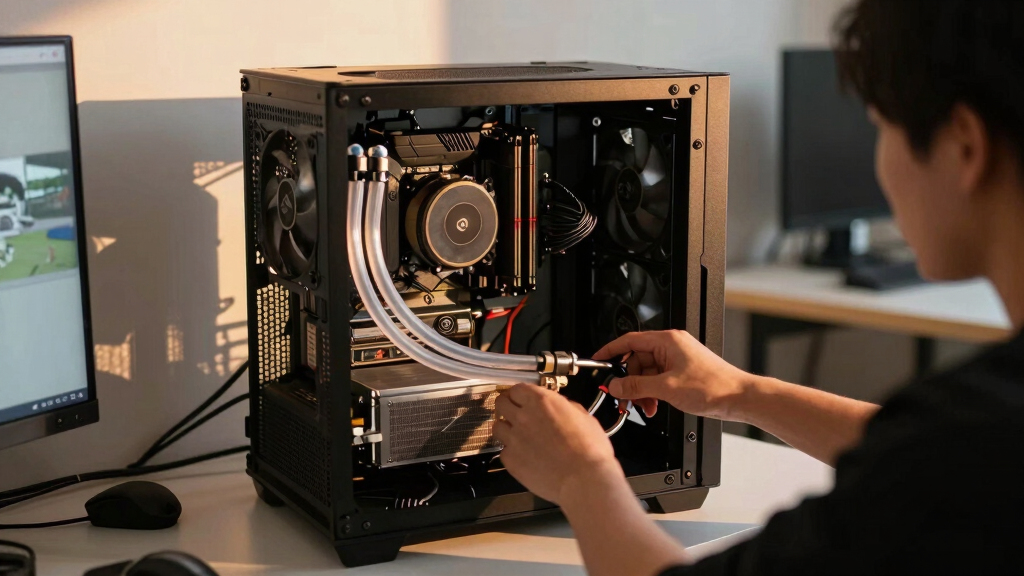
Liquid cooling, specifically all-in-one (AIO) units, can handle higher thermal loads—up to 360W—making them suitable for the hottest CPUs or overclocked setups. They also provide better heat export in confined or non-climate-controlled environments. However, AIOs contain moving parts, such as pumps, which have limited lifespans and pose potential failure risks over years of continuous operation.
Manufacturers typically warranty AIOs for 5–6 years, but the pumps tend to wear out faster, and coolant permeation can reduce effectiveness over time. In contrast, air coolers are mostly static, with fans that are easily replaced and heatsinks that last decades, making them more dependable for long-term, unattended use.
Liquid vs air
for a 24/7 inference rig.
For an always-on machine the question isn’t “which cools better” — it’s which one still works in three years without you thinking about it. That reframing makes air the default for most rigs. Answer three questions in Part 2 to find yours.
- Nothing to fail — fan swaps in minutes
- Lasts a decade+; lower total cost
- Quieter floor — no pump hum (~40–45 dBA)
- Trivial maintenance — wipe & repaste
- Tall — can block RAM, dumps heat in case
- Best headroom — ~360W TDP sustained
- Compact block — fits tight cases, clears RAM
- Exports heat out the radiator & room
- Pump fails at 5–7 yrs; replace whole unit
- Costs 2–3× more over its life; pump hum
- You run it 24/7 and want set-and-forget.
- Your CPU is mainstream-to-high-end (or power-capped).
- A big tower fits your case.
- You value lower cost and a quieter floor.
- Your CPU is too hot for air under sustained all-core load.
- A big tower won’t fit (compact / multi-GPU case).
- You need to export heat out of a warm room.
- RAM clearance is tight.
Why Reliability and Cost Matter for AI Inference Systems
Choosing the right cooling impacts the operational reliability, maintenance costs, and noise levels of AI inference rigs. Air cooling's durability and simplicity reduce downtime and repair expenses, which is critical for systems that run continuously without human oversight. While liquid cooling offers thermal headroom advantages, its potential for failure and higher lifetime costs make it less suitable for most set-and-forget applications.
Understanding these tradeoffs helps organizations optimize their hardware investments, ensuring consistent performance over years and minimizing unexpected failures that could disrupt AI inference systems.
As an affiliate, we earn on qualifying purchases.
Cooling Choices in the AI Hardware Landscape
The debate between liquid and air cooling has traditionally centered on gaming and overclocking, where peak temperatures matter most. However, AI inference systems prioritize long-term stability and unattended operation. Industry consensus indicates that high-quality air coolers can handle most CPU loads without issue, and their simplicity makes them the default for many enterprise and research setups.
Liquid cooling gained popularity in high-performance computing for managing extreme thermal loads, but its advantages diminish in typical AI inference workloads that do not push CPUs to their absolute thermal limits. The longer lifespan and lower maintenance of air cooling align better with the continuous operation needs of inference rigs.
"For most 24/7 inference systems, air cooling's reliability and low maintenance outweigh the thermal headroom benefits of liquid cooling."
— Thorsten Meyer, AI hardware expert
As an affiliate, we earn on qualifying purchases.
Remaining Questions About Long-Term Reliability
While current data supports air cooling's reliability, long-term operational data spanning multiple years is limited. The actual lifespan of AIO pumps under continuous load remains somewhat uncertain, and real-world failure rates vary by manufacturer and model. Additionally, the impact of coolant permeation over extended periods has not been fully quantified in all setups.
reliable 24/7 AI inference cooling system
As an affiliate, we earn on qualifying purchases.
As an affiliate, we earn on qualifying purchases.
Monitoring and Future Developments in Cooling Technology
As AI hardware continues to evolve, future research may clarify the long-term performance differences between cooling methods. Manufacturers could improve pump longevity or develop more reliable liquid cooling systems. Meanwhile, users should prioritize proven, high-quality air coolers for most 24/7 inference applications and consider liquid cooling only when specific thermal constraints demand it.
As an affiliate, we earn on qualifying purchases.
Key Questions
Is liquid cooling always better for high-thermal CPUs?
No, not necessarily. While liquid cooling can handle higher sustained loads, for most AI inference rigs operating continuously, high-quality air coolers provide sufficient thermal management with greater reliability and lower maintenance.
How often do AIO pumps typically fail?
Manufacturers warranty AIO pumps for 5–6 years, but actual failure rates vary. Pumps tend to wear out faster under continuous operation, which can lead to leaks or cooling failure over time.
Can I switch from air to liquid cooling later?
Yes, but it involves disassembling the system and may require case modifications. For most long-term, unattended AI systems, choosing the right initial cooling method is preferable.
Does noise level differ significantly between the two?
High-quality air coolers are often quieter under load than AIOs, which include a pump that adds a constant hum. This can impact user comfort if the system is placed nearby.
Source: ThorstenMeyerAI.com
Fall Picks
fall essentials
As an affiliate, we earn on qualifying purchases.