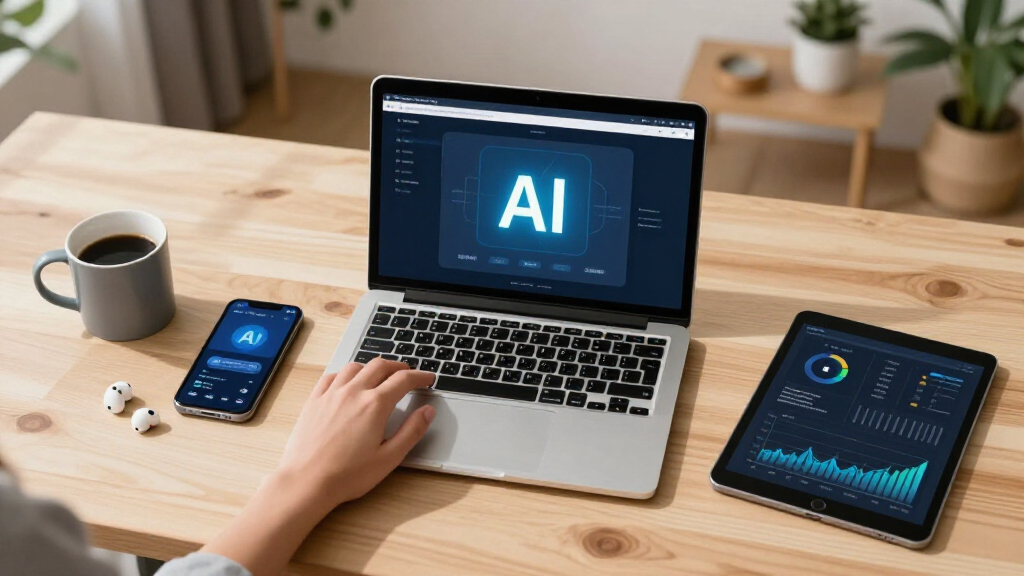

🔍 Read the full analysis: Exploring The 9 Best AI Advancements Of 2026 on ThorstenMeyerAI.com

Get the latest gadgets delivered free with Prime
- Fast, free delivery on millions of items
- Prime Video, Amazon Music and more included
- Member-only deals all year
TL;DR
In 2026, nine major AI advancements have emerged, transforming industries from healthcare to automation. This report details each breakthrough, their confirmed capabilities, and future potential.
Nine groundbreaking AI innovations have been confirmed in 2026, reshaping sectors such as healthcare, automation, and creative industries. These advancements are driven by rapid research progress and commercial deployment, marking a notable year for artificial intelligence’s development.
Among the confirmed developments, the most notable include the release of GPT-7, which offers advanced language understanding and generation capabilities, and the emergence of autonomous AI systems capable of complex decision-making in real-time environments. Additionally, new AI models have demonstrated improvements in medical diagnostics, enabling earlier and more accurate detection of diseases.
Other confirmed advancements involve AI-driven creative tools that produce art and music with human-like nuance, and the deployment of AI in climate modeling, providing more precise predictions for environmental changes. Several companies have announced AI systems capable of self-improvement through reinforcement learning, extending the potential for machine autonomy. While these innovations are confirmed by multiple industry sources, details about their full capabilities and limitations are still emerging, and some claims remain under review. For more context, see the original analysis.
The 9 picks
- 1
 Elgato 4K S Capture Card for PS5, Xbox Series X/S, Switch 2View on Amazon →
- 2
 XIIXMASK USB 3.0 HDMI Capture Card, 4K60FPS Capture with Pass-ThroughView on Amazon →
- 3
 XIIXMASK USB 3.0 HDMI Capture Card, 4K60FPS Capture with Pass-ThroughView on Amazon →
- 4
 Acer USB 3.0 HDMI Capture Card, 4K HDMI Loop-Out, 1080P 60Hz for StreamingView on Amazon →
- 5
 4K HDMI Video Capture Card, 1080P 60FPS Game Capture Device for StreamingView on Amazon →
- 6
 4K HDMI Capture Card for Streaming, Full HD 1080P 60FPS USB 3.0 Cam Link Game…View on Amazon →
- 7
 Capture Card 4K HDMI Video Streaming to USB 3.0 1080P 60FPS Capture DeviceView on Amazon →
- 8
 4K Capture Card Game Capture Card 1080P 60FPS for StreamingView on Amazon →
- 9
 4K USB3.0 HDMI Video Capture Card for Streaming and RecordingView on Amazon →
Impacts of 2026’s Top AI Breakthroughs
The confirmed AI advancements of 2026 are expected to influence various sectors. Healthcare benefits include earlier disease detection and personalized treatment plans, which could improve patient outcomes. In automation, AI systems are increasingly capable of handling complex tasks, potentially reducing human workload and increasing efficiency. Creative industries are experiencing new opportunities as AI tools generate high-quality content, influencing traditional workflows.
Furthermore, improvements in climate modeling may assist policymakers in making more informed decisions. These developments also raise important questions about AI safety, ethics, and potential job displacement, emphasizing the need for ongoing oversight. Overall, these breakthroughs indicate a move toward more autonomous, intelligent systems that could influence societal norms and economic structures.
Products Worth Considering

Bose TV Speaker Compact Soundbar with Bluetooth and HDMI-ARC, Black

Bose SoundLink Flex Bluetooth Speaker (2nd Gen) – Portable Outdoor Speaker with Hi‑Fi Audio, Waterproof and Dustproof, USB‑C, Up to 12 Hours

Logitech MX Master 4 for Mac Wireless Ergonomic Mouse, Space Black
As an affiliate, we earn on qualifying purchases.
2026’s AI Innovations in Perspective
The year 2026 follows a decade of rapid AI growth, with earlier milestones such as GPT-4 and AlphaFold establishing a foundation for more advanced systems. This year’s breakthroughs build upon years of foundational research in deep learning, reinforcement learning, and natural language processing.
Recent years have seen increased investment from both established tech companies and startups, accelerating the pace of innovation. Prior to 2026, AI models faced limitations in understanding context, reasoning, and autonomy. The current advancements address many of these challenges, with some systems approaching human-level reasoning and decision-making. While some claims about capabilities are still preliminary, the overall trajectory suggests a rapid progression toward highly capable, self-improving AI systems, with ongoing discussions about safety and governance.
Unconfirmed Capabilities and Future Risks
While many of the nine advancements are confirmed, some claims regarding AI systems’ full autonomous decision-making, safety measures, and ethical safeguards remain unverified or are in early testing phases. The long-term implications of self-improving AI models are under ongoing discussion, with experts highlighting potential risks if oversight is insufficient.
Details about the scalability, robustness, and real-world deployment of some systems are still emerging, and regulatory frameworks are only beginning to adapt to these technological changes. It remains uncertain how these AI systems will perform outside controlled environments or how they will be integrated into societal structures.
Next Steps for AI Development and Regulation
Researchers and industry leaders are expected to prioritize validation of the safety and reliability of these AI systems through systematic testing and peer review. Governments and international organizations are beginning to draft regulations aimed at managing AI deployment, with an emphasis on transparency and ethical standards.
In the coming months, further updates on the capabilities and limitations of these systems are anticipated, along with discussions on governance and safety protocols. Commercial adoption of AI is likely to increase, with applications expanding into healthcare, climate science, and creative industries, influencing the technological landscape of 2027 and beyond.
Key Questions
Which AI advancement of 2026 has the most immediate impact?
The deployment of autonomous AI decision-making systems in healthcare and climate modeling is expected to have the most immediate societal impact, improving diagnostics and environmental predictions.
Are these AI advancements safe to use at scale?
While many systems have passed initial safety assessments, comprehensive validation and regulatory oversight are still in progress. Caution is advised until full safety and ethical standards are established.
Will AI replace human jobs in 2026?
Some automation of tasks is occurring, especially in manufacturing and data analysis, but widespread job displacement remains uncertain. The focus is also on AI augmenting human work rather than replacing it entirely.
How soon will these AI systems be available to the public?
Many of the advancements are in early deployment phases or pilot programs, with broader availability expected within the next 1-2 years as systems mature and regulations are implemented.
What are the main ethical concerns associated with these advancements?
Key concerns include transparency of AI decision-making, mitigation of biases, safety in autonomous systems, and potential misuse. Ongoing discussions aim to establish responsible development standards.
Source: ThorstenMeyerAI.com