📊 Full opportunity report: How To Organize Parental Consent Across Kid-Facing Products on IdeaNavigator AI — validation score, market gap, and execution plan.

Get the latest gadgets delivered free — and shop member deals
- Fast, free delivery on millions of items
- Access to Prime Big Deal Days deals on October 6–7
- Prime Video, Amazon Music and more included
TL;DR
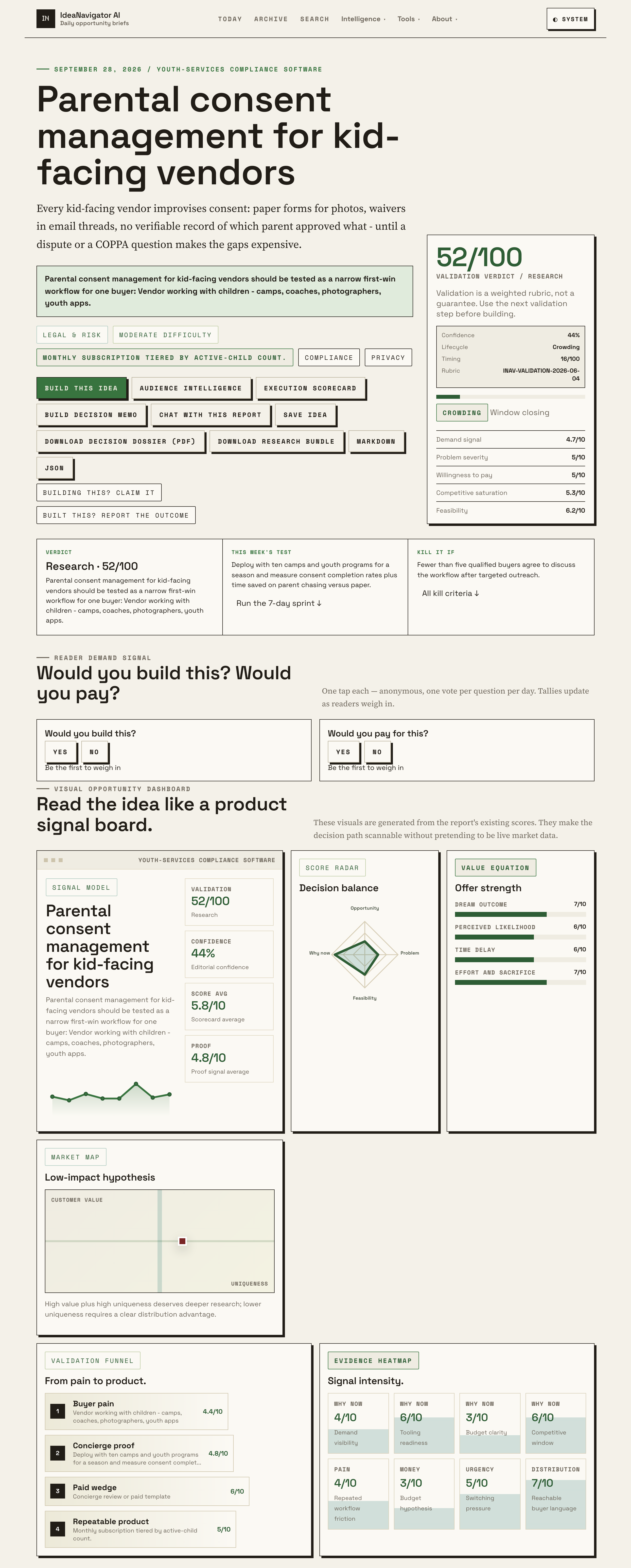
IdeaNavigator AI has outlined a business concept for a parental consent platform aimed at camps, coaches, photographers and youth apps. The proposal calls for phone-based forms, per-child records and audit exports, but it does not report a launched product, pilot results or customer commitments.
IdeaNavigator AI has proposed a parental consent-management service for businesses that work with children, including camps, coaches, photographers and youth apps. The concept would replace scattered forms and email approvals with phone-based consent flows and per-child records, but the proposal describes an idea to test, not an operating product or a completed pilot.
The problem identified in the proposal is that child-facing vendors may collect permission in different ways: paper forms for photographs, waivers in email threads and other records that may not show which parent approved which use. IdeaNavigator AI says those gaps could become costly during a dispute or a question about compliance. The proposal does not document specific disputes, enforcement actions or measured losses.
The suggested minimum product would let each vendor offer branded consent forms that parents can complete on their phones. The listed permissions cover photo use, data collection, medical information and liability. The system would also keep a consent ledger for each child, track expiry dates and provide an audit export. Identity checks would vary according to the perceived risk of the permission, though the proposal does not specify how those checks would work.
For an initial test, IdeaNavigator AI recommends working with ten camps and youth programs for one season. The proposed measures are consent completion rates and time saved chasing parents compared with paper-based processes. The concept would charge vendors a monthly subscription priced by the number of active children. No participating programs, prices, product release date or pilot findings are identified.
A Record for Every Permission
For a small organization, a consent record can affect whether staff know they may post a child’s photograph, collect information or rely on a medical authorization. A centralized ledger could make it easier to find what was approved, for which child and when, particularly when permissions expire or families change their choices. That is the practical value the proposal is aiming to test.
The idea also addresses a gap between large organizations with dedicated compliance systems and smaller providers that may handle forms through paper and inboxes. If a service reduces follow-up work while giving vendors records they can retrieve, it could appeal to operators with limited administrative capacity. Those benefits remain expected outcomes, not demonstrated results: the proposal supplies no completion-rate data, time comparisons or evidence that vendors would pay for the service.
There is also a distinction between organizing consent and establishing that a particular consent process satisfies legal requirements. A digital signature or stored record alone does not show whether the right person approved a specific use or whether the form met the rules that apply. The proposed product would operate in an area shaped by children’s privacy requirements and differing uses of data, so its safeguards and legal fit would matter to buyers as much as convenience.
From Paperwork to a Pilot
IdeaNavigator AI frames the opportunity as youth-services compliance software and advises beginning with one buyer group: vendors that work directly with children. Camps and youth programs are the proposed starting point for validation, while coaches, photographers and youth apps appear as other potential users. This is a market proposal, not evidence that all those businesses share the same paperwork needs.
The rationale offered is that attention to children’s privacy is growing amid COPPA updates, state laws and parent challenges to photo or data use. The proposal does not cite particular statutes, enforcement cases or dates, and it does not establish how any given rule would apply to a specific vendor. Its argument is that changing expectations may make defensible records more valuable, including for smaller organizations.
The recommended sequence is deliberately limited: test with ten camps or youth programs for a season, then review completion and staff time. That would provide an initial view of whether the forms fit real enrollment routines. It would not, by itself, establish demand across the wider youth-services market or prove that the service meets every legal or security need.
Demand and Safeguards Unproven
The proposal leaves several central questions unanswered. It names no product team, launch date, participating vendors, subscription price or completed customer interviews. There are no pilot results showing whether parents finish mobile forms more often, whether vendors save time or whether organizations will pay according to active-child counts.
It is also unclear how the platform would verify a parent’s identity, protect sensitive records, handle access by multiple guardians, record consent withdrawals or support vendors with different legal obligations. The proposed categories include medical information and liability waivers, but the plan does not describe data retention, security controls, integrations or document review. Those details could shape both customer trust and the cost of operating the service.
Finally, the proposal’s broad regulatory rationale is not tied to an analysis of particular jurisdictions or vendor types. What records a camp needs may differ from what a photographer or app operator needs. Whether one standard workflow can serve those groups remains an open product question.
Ten Programs Would Test the Idea
The next step described by IdeaNavigator AI is a seasonal pilot with ten camps and youth programs. A useful evaluation would compare consent completion and staff time against each program’s existing process, while also tracking whether parents can understand the choices and correct or withdraw permissions. The proposal does not state that the pilot has been scheduled or that any organizations have agreed to take part.
Before a wider rollout, the concept would need clearer answers on identity checks, records management, privacy protections, legal review and pricing. Results from a defined pilot could show whether vendors experience the paperwork problem often enough to adopt a subscription service. Until such results or a product announcement emerge, the platform remains a business concept, with its customer demand and effectiveness unconfirmed.
Source: IdeaNavigator AI
Key Questions
Has a parental consent platform launched?
The material describes a proposed product, not a launched service. It gives no release date or product name.
Who is the proposed service for?
The initial test is aimed at camps and youth programs. Coaches, photographers and youth apps are also named as possible users.
What would the product do?
It would offer phone-based consent forms, per-child records, expiry tracking and audit exports. The proposed forms cover photo use, data collection, medical information and liability.
Has the ten-program pilot started?
No pilot start date or participating organizations are identified. Testing with ten programs for a season is a recommendation in the proposal.
How would the service make money?
The proposed model is a monthly subscription tiered by active-child count. No subscription prices or customer commitments are provided.
Source: IdeaNavigator AI
Fall Picks
fall essentials
As an affiliate, we earn on qualifying purchases.