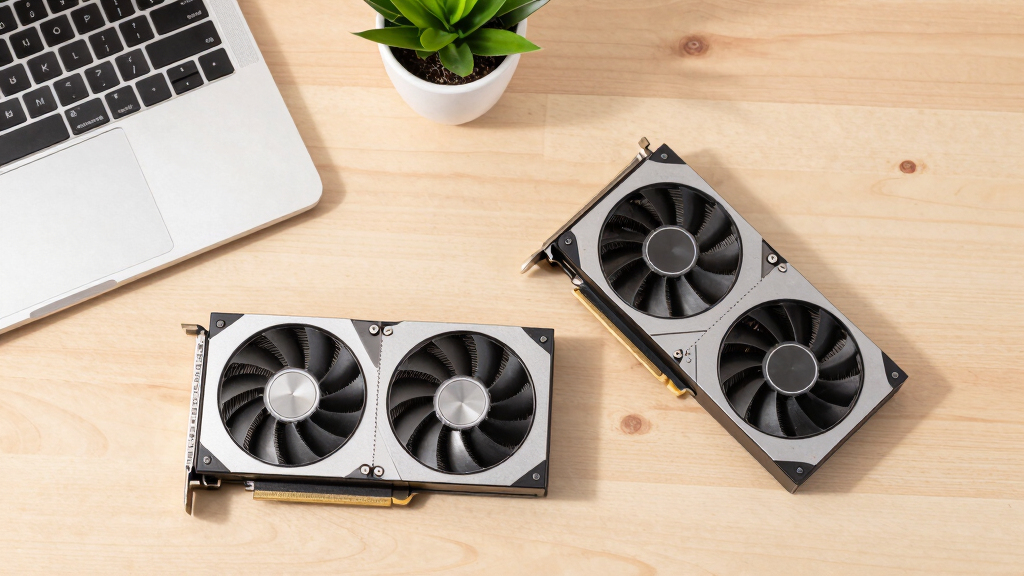

📊 Full opportunity report: Quiet GPUs for Local AI: Acoustic and Thermal Roundup on ThorstenMeyerAI.com — validation score, market gap, and execution plan.
TL;DR
This roundup evaluates the quietest GPUs for local AI in 2026, emphasizing thermal and acoustic performance. The RTX 5090 stands out as the top choice for large models, while other cards offer cost-effective or efficient options. Power-capping and cooling choices are key to minimizing noise and heat.
In 2026, the most significant development in local AI hardware is the emergence of GPUs that prioritize quiet operation and thermal efficiency without sacrificing inference performance. The RTX 5090 with 32GB VRAM is identified as the top consumer GPU for large models, provided it is power-capped and paired with an effective cooling system. This shift addresses the longstanding challenge of noise and heat in high-power AI setups, making local AI more accessible and practical for users sitting nearby.
The RTX 5090 remains the premier consumer GPU for local AI in 2026, offering 32GB of GDDR7 VRAM and high bandwidth, capable of running 70B models at Q4 quantization without offloading. Learn more about quiet GPUs for local AI. Despite its 575W TDP, power-capping it to around 70% and choosing a high-quality triple-fan cooler significantly reduces heat and noise, transforming it into a viable, quieter option for dedicated AI rigs.
For budget-conscious users, the RTX 4090 and used RTX 3090 continue to serve as reliable 24GB options, with the latter providing a cost-effective entry point into serious local AI. Both cards benefit from power-capping and good cooling to keep noise levels manageable. Meanwhile, the RTX 5080 and RTX 4060 Ti with 16GB VRAM are recommended for smaller models in the 7–34B range, offering lower power consumption and quieter operation.
On the professional side, the RTX PRO 6000 Blackwell with 96GB VRAM is designed for dense, large-scale models, balancing high performance with thermal management. The overall trend emphasizes undervolting and superior cooling solutions to keep GPUs quiet under sustained loads, rather than relying solely on silicon quality.
Quiet GPUs
for local AI.
The GPU makes ~70% of your heat and most of your noise. But here’s the secret: the chip doesn’t decide how loud your card is — the cooler design and your power settings do. Match your VRAM tier in Part 2, then make it quiet.
Capping to 70–80% sheds a huge amount of heat for almost no inference loss — because inference is memory-bound. A capped 5090 is dramatically cooler & quieter than stock. Do this first.
Within one GPU model, partner cards differ enormously. For a single card, a large triple-fan open-air with zero-RPM idle runs slow & quiet. For multi-GPU, the calculus flips →
With room to breathe, a large triple-fan open-air cooler spreads heat across a big fin stack and runs its fans slowly. The quietest choice — what most people should buy.
Why Quiet GPUs Matter for Local AI Setups
Quiet GPUs are essential for making local AI deployment feasible in office or home environments, where noise and heat can be disruptive. By focusing on thermal and acoustic performance, users can build high-performance AI rigs that operate silently and with less cooling infrastructure, reducing costs and increasing comfort. This development broadens access to advanced local AI, enabling more researchers, developers, and hobbyists to run large models without the need for industrial-grade cooling systems.

ASUS ROG Astral NVIDIA GeForce RTX 5090 32GB GDDR7 OC Edition Gaming Graphics Card (PCIe 5.0, HDMI/DP 2.1, 3.8-Slot, 4-Fan Design, Axial-tech Fans, Patented Vapor Chamber), 3 Year Warranty
Powered by the NVIDIA Blackwell architecture and DLSS 4
As an affiliate, we earn on qualifying purchases.
As an affiliate, we earn on qualifying purchases.
Evolution of GPU Cooling and Noise Management in 2026
Historically, high-power GPUs like the RTX 4090 and 5090 have been associated with significant heat and noise, often limiting their use in proximity to users. For detailed cooling considerations, see best thermal paste and pads for high-TDP GPUs. Recent advancements have shifted focus toward undervolting and improved cooling designs, with partner manufacturers offering variants that prioritize silent operation. Power-capping has become a popular method to reduce heat output with minimal performance loss, especially in inference workloads which are memory-bound. The trend reflects a broader industry effort to balance raw performance with user comfort and operational practicality.
"Power-capping a GPU to around 70% is a game-changer for noise and heat management, making high-end cards like the RTX 5090 viable for quiet, dedicated AI setups."
— Thorsten Meyer, AI hardware expert

ASUS ROG Astral GeForce RTX 5090 White OC Edition GPU, 32GB GDDR7, 3352 AI Tops, DLSS 4, 512-bit, DP 2.1b x3, HDMI 2.1b x2, AI Content Creation, LLM Inference, with GPU Holder
[3352 AI TOPS, 5th Gen Tensor Cores, AI Content Creation] Accelerate AI-powered photo and video workflows like upscaling,...
As an affiliate, we earn on qualifying purchases.
As an affiliate, we earn on qualifying purchases.
Remaining Questions About Long-Term Reliability and Real-World Noise
While power-capping and cooling improvements significantly reduce noise and heat, it is still unclear how these configurations perform over extended periods or in different ambient environments. Long-term reliability of undervolted, heavily cooled GPUs has not been fully documented, and real-world noise levels may vary depending on case design and airflow. Further testing is required to confirm these strategies' effectiveness across diverse setups.

GDSTIME Graphic Card Fans, PCI Slot 3X 90mm 92mm Fans, Graphics Card Cooler
Package include: 1 Piece Graphic Card Fans ( 3-Fans connected ) with 1*Power D-type Interface cable
As an affiliate, we earn on qualifying purchases.
As an affiliate, we earn on qualifying purchases.
Next Steps for Achieving Even Quieter, Cooler Local AI GPUs
Manufacturers are expected to introduce more specialized cooling variants and refined power-management features in upcoming GPU models. This will help improve long-term reliability and noise reduction in local AI setups. User communities and OEMs will likely share best practices for optimizing undervolting and cooling configurations. Continued focus on thermal and acoustic optimization will enable broader adoption of high-performance local AI hardware in everyday environments, with future developments possibly including integrated noise-reduction technologies.

P4 8GB GPU Deep Learning Accelerated Computing Graphics Card
P4 8GB GPU Deep Learning Accelerated Computing Graphics Card
As an affiliate, we earn on qualifying purchases.
As an affiliate, we earn on qualifying purchases.
Key Questions
Can power-capping significantly reduce GPU noise in practice?
Yes, power-capping reduces heat output, which in turn allows cooling fans to operate more quietly while maintaining most inference performance.
What GPU models are best for a quiet, small-scale local AI setup?
The RTX 5080 and RTX 4060 Ti 16GB are recommended for efficiency and low noise in moderate model workloads, typically in the 7–34B range.
How important is cooler design compared to silicon quality for noise reduction?
Cooler design is equally critical; large, well-ventilated coolers with features like zero-RPM mode greatly enhance quiet operation regardless of silicon quality.
Will these quiet GPU configurations be reliable over time?
Long-term reliability data is still emerging; ongoing testing will clarify how well these configurations perform over extended periods under sustained loads.
What should I consider when building a quiet GPU-based AI workstation?
Prioritize power-capping, choose a partner card with a high-quality cooling solution, and ensure adequate airflow and case design for optimal noise reduction.
Source: ThorstenMeyerAI.com